
What Does an Employer-Led Workforce Board Actually Mean?

Posted by: Brian Hernandez
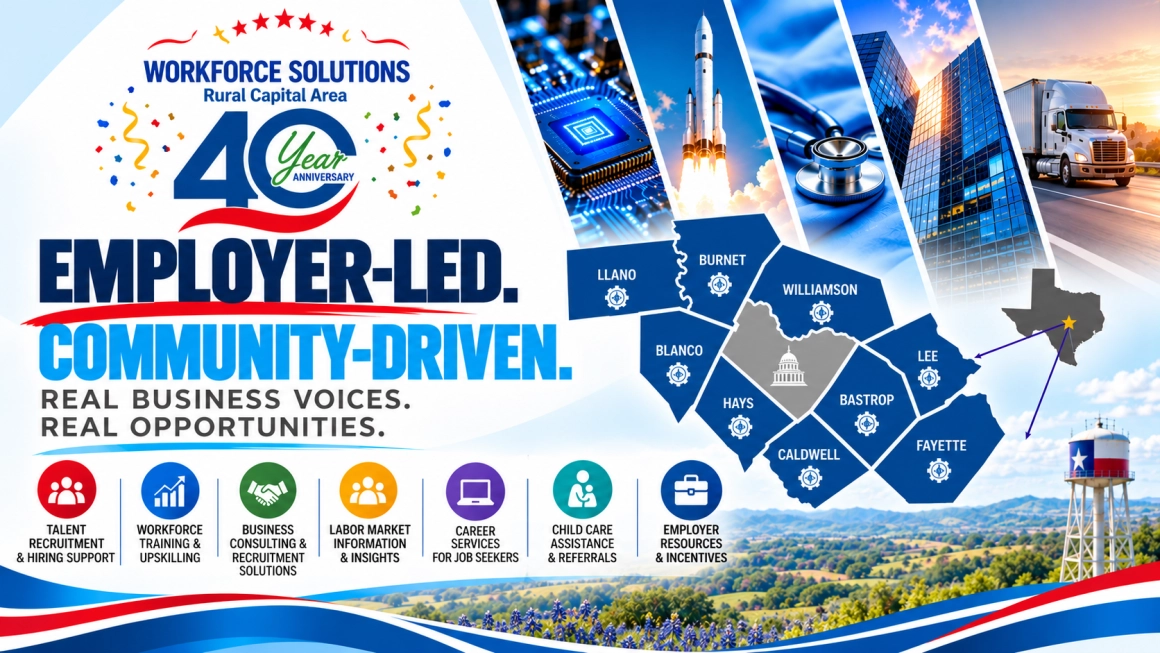
Why the people creating jobs should have a say in preparing people for them.
Imagine running a restaurant where the people designing the menu never talk to the customers.
Or building a house without asking the homeowner what they need.
Sounds a little backward, doesn't it?
Now imagine trying to prepare thousands of people for careers without talking to the businesses that will actually hire them.
That's why our workforce system is designed a little differently.
And as Workforce Solutions Rural Capital Area (WSRCA) celebrates 40 years of connecting people, businesses and opportunity, it's worth looking at one of the principles that has helped guide our work from the beginning.
Employers don't just have a seat at the table. They help lead the conversation.
And there's a good reason for that.
Our all-volunteer Board of Directors brings together business leaders and representatives from education, economic development, labor, workforce organizations and community partners.
Federal workforce law requires that a majority of local workforce board members represent businesses. That gives employers a leading voice in setting priorities and shaping workforce strategies.
Why? Because they're the ones hiring people, investing in equipment, expanding operations and figuring out what skills they'll need next.
They see changes happening in their industries, sometimes long before those changes show up in employment reports.
But being employer-led doesn't mean we're only focused on businesses. It means we're connecting what employers need with what people need to build successful careers.
Those two goals go hand in hand.
Four Decades of Local Leadership
Our workforce system has changed quite a bit since the 1980s.
When our region's workforce leadership first began taking shape, personal computers were just finding their way into workplaces, the internet wasn't part of everyday life and artificial intelligence certainly wasn't reshaping entire industries.
The Rural Capital Area Private Industry Council helped lay the groundwork for the employer-led workforce system we know today. WSRCA was formally incorporated in 1987, and over the following decades, workforce programs, industries and technologies continued to evolve.
But one idea has remained remarkably consistent.
The people who understand their local economy should help shape its workforce future.
That's especially important in a region as large and diverse as ours.
For 40 years, local leadership, business involvement and community partnerships have helped connect workforce investments with real opportunities.
And while the jobs have changed, our commitment to helping people prepare for them hasn't.
So What Does the Board Actually Do?
Think of our Board as a group of community leaders helping answer some pretty important questions.
Where are the jobs going to be? What skills will employers need? Which industries are growing? And how do we make sure people across our region have access to those opportunities?
Those conversations help guide decisions about workforce investments, training partnerships, services and long-term priorities.
For example, if manufacturers are struggling to find qualified technicians, we can work with employers and education partners to develop training that addresses those needs.
If healthcare providers need more workers, we can explore ways to strengthen career pathways into that industry.
And if businesses are struggling because employees can't find affordable child care, that's a workforce issue, too.
The goal isn't to train people just to earn a certificate. It's to help people develop skills that lead to real opportunities.
One Region. Nine Counties. Very Different Needs.
Here's where local leadership becomes especially important.
Our Rural Capital Area includes Bastrop, Blanco, Burnet, Caldwell, Fayette, Hays, Lee, Llano and Williamson counties.
And while we're one workforce region, we're certainly not one-size-fits-all.
The workforce needs of a semiconductor manufacturer in Williamson County may look very different from those of a healthcare provider in Burnet County, a construction company in Hays County or a small business in Fayette County.
Some communities are experiencing rapid industrial growth. Others are working to expand access to training, transportation, child care or career opportunities closer to home.
A workforce strategy that works in one county might not be the right answer for another.
That's why having local employers and community leaders involved in these decisions is so valuable.
The people closest to the challenges often have the best understanding of what it takes to solve them.
Employers Don't Just Tell Us What They Need
Here's another important part of the equation.
Employers aren't simply handing us a wish list and expecting someone else to deliver.
Many help shape training programs, provide insight into changing technology, participate in career events, offer work-based learning opportunities and connect directly with future employees.
Some serve on committees or work with our industry partnerships to address challenges affecting entire sectors.
And those relationships help us look beyond today's job openings.
What skills will matter five years from now? How will artificial intelligence change the workplace? Which careers will offer the strongest opportunities for advancement?
Those are the kinds of conversations that help our region prepare for what's next.
After 40 years, we've learned that building a strong workforce isn't something any one organization can do alone. It's a team effort.
What Does This Mean for Job Seekers?
Quite a bit, actually.
When employers help shape workforce priorities, job seekers can benefit from training that's better connected to real hiring needs.
It also creates opportunities for people who might not follow a traditional career path.
Maybe you're a high school graduate exploring an apprenticeship. A parent returning to work. Someone changing careers after 20 years. Or an experienced worker looking to learn new technology.
Our job is to help connect your potential with opportunity.
That might mean career guidance, training assistance, child care support, job search resources or an introduction to an employer.
And sometimes, it means helping employers recognize talent they might otherwise overlook.
Because workforce development isn't just about filling open positions.
It's about helping people build careers worth having.
Why Should You Know Who's on Our Board?
Because these aren't just names on an organizational chart.
They're business owners, executives, educators and community leaders who understand what's happening across Central Texas.
They bring different perspectives, but share a common responsibility: helping our region build a workforce that supports both economic growth and individual opportunity.
Their decisions help shape how workforce resources are used, which partnerships are developed and how we prepare for changing demands.
And they volunteer their time and expertise to help make that happen.
As we celebrate our 40th anniversary, we're also celebrating the generations of volunteer leaders who've helped guide our organization through decades of economic change.
Their commitment is part of our history. And today's Board is helping write the next chapter.
Forty Years of Opportunity. A Future We're Building Together.
Think about how much the world of work has changed in 40 years.
Entire industries have emerged. Technology has transformed how we work. Careers that didn't exist a generation ago are now shaping our regional economy.
And the next 40 years will bring changes we can't even imagine today.
But one thing won't change.
Strong communities need strong businesses. Strong businesses need talented people. And talented people deserve access to opportunities that help them succeed.
That's what an employer-led workforce Board helps make possible.
Employers help us understand where opportunity is headed. Our workforce system helps people get there.
It's a partnership that has helped shape our first 40 years and will continue guiding us into the future.
Get to know our distinguished WSRCA Board of Directors, whose leadership and dedication are helping shape the next 40 years of opportunity across our region.