
WSRCA Board Member Amy Payne Champions Child Care and Workforce Development at Texas Capitol

Posted by: Brian Hernandez
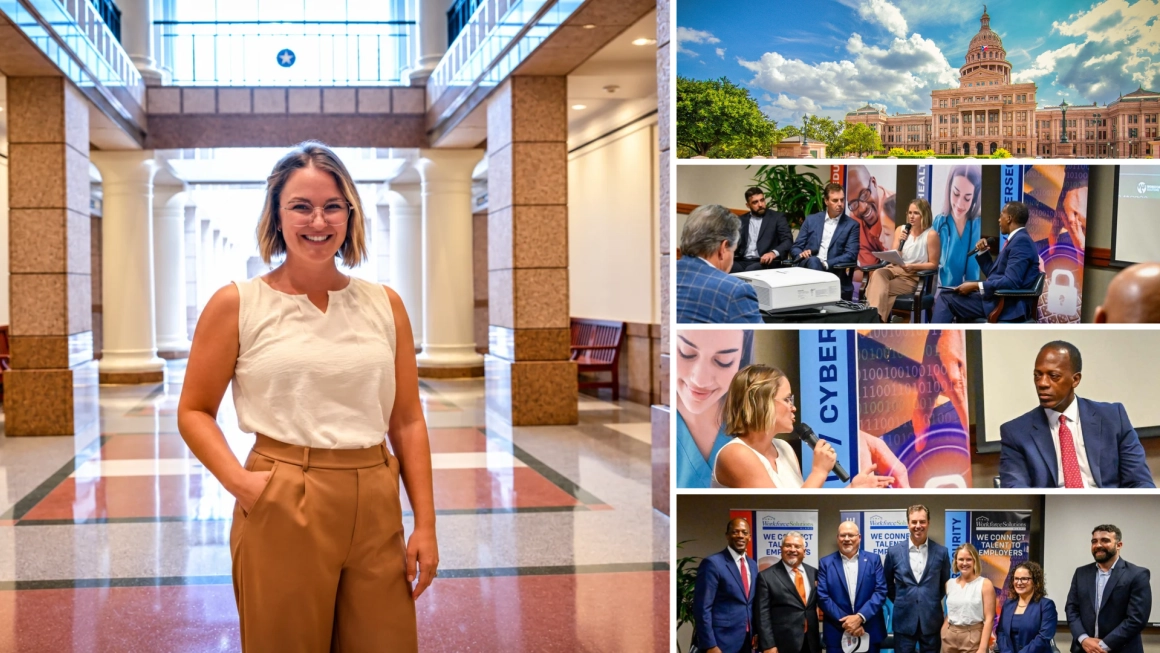
Local preschool owner brings a powerful employer perspective to statewide workforce discussion, highlighting why child care is essential to working families, business growth and Texas' economic future.
What does child care have to do with Texas' economic future?
“Just about everything,” says Amy Payne, owner and director of Mrs. Amy's Adventures Preschool, based in Liberty Hill, and a member of the Workforce Solutions Rural Capital Area (WSRCA) Board of Directors.
Amy brought that message to the Texas Capitol during our recent Powering Texas' Workforce & Economy Luncheon, joining fellow business leaders for an important conversation about the challenges and opportunities shaping our state's workforce.
Her message was simple but powerful: Child care isn't just about taking care of children. It's about supporting working parents, strengthening businesses and preparing the next generation of Texans for success.
Amy summed up that connection during the discussion:
"Reliable child care provides direct workforce stabilization, and Workforce Solutions supports us in each of these important and impactful ways."
Her words reinforced why keeping child care services connected to Texas' local workforce development boards matters. When families have dependable care and access to employment resources, parents can remain in the workforce, employers can retain valuable talent and communities can build stronger economies.
Amy's Perspective: One Family, Multiple Needs, One Workforce System
As a preschool owner, Amy sees the connection between child care and employment every day.
The parents who bring their children to her preschool are also employees, job seekers, students and future business leaders. Their ability to work, pursue training and advance their careers often depends on having reliable, affordable child care.
But as Amy explained, families frequently need more than child care alone.
Some parents may need help finding employment. Others may benefit from career training, job placement assistance or connections to employers offering better opportunities.
That's why wraparound care and support are so important. Providing access to child care is only one piece of the puzzle. Families also need a coordinated network of resources that helps them overcome barriers to employment, achieve financial stability and build a pathway toward long-term success.
That's where Texas' workforce development system makes a difference.
Through local workforce development boards like WSRCA, eligible families can access child care assistance alongside a broader network of employment, education and training services.
It's a one-stop approach that connects families with customized solutions instead of making them navigate multiple disconnected systems.
For child care providers like Amy, that connection is especially valuable. The workforce system can help support the families they serve while also helping providers address their own business and workforce challenges.
And for employers, it means access to a coordinated system designed to help workers overcome barriers, develop skills and remain employed.
Amy's perspective reinforced an important point for the policymakers in attendance.
Families don't experience child care, employment and career advancement as separate challenges. Our workforce system shouldn't treat them that way, either.
The Heckman Equation: Investing in Children Is Investing in Our Economy
Amy also brought research into the conversation, highlighting the work of Nobel Prize-winning economist James Heckman.
His research, commonly known as the Heckman Equation, examines the long-term economic value of investing in high-quality early childhood development.
One of its most compelling findings is an estimated 13% annual return on investment from comprehensive, high-quality early childhood programs serving disadvantaged children from birth through age five.
That return reflects long-term benefits associated with improved education, health, employment and earnings, along with reduced social costs. It's a finding from specific programs studied, not a guaranteed return for every child care program.
But the broader message is especially relevant to workforce development.
When we invest in children early, we're helping prepare tomorrow's workforce while supporting today's working families.
Quality early childhood education helps children develop the foundational skills they'll carry into school, future training and eventually the workplace.
At the same time, dependable child care helps parents participate in the economy today.
It's an investment with benefits that can extend across generations.
Amy's reference to the Heckman Equation helped connect the daily work of child care providers with a much larger economic conversation.
Child care isn't simply an expense to be managed. High-quality early childhood education is an investment with the potential to produce lasting returns for families, businesses and communities.
What Amy's Message Means for Our Nine-County Region
Across the nine-county Rural Capital Area, our communities are growing and employers are working to attract and retain skilled talent.
From healthcare and advanced manufacturing to technology, construction and skilled trades, businesses depend on a workforce that's ready and able to work.
But even the best job opportunity means little to a parent who can't find dependable child care.
Consider a parent in Williamson County who wants to pursue healthcare training, a manufacturing employee in Bastrop County balancing changing work schedules or a family in Hays County trying to advance their careers while managing child care costs.
Their circumstances may be different, but their challenges are connected.
And those challenges have real consequences for our regional economy.
When parents can't access dependable care, employers may face staffing shortages, absenteeism and turnover. When families have the support they need, businesses have a better opportunity to retain employees and build stable teams.
That's why Amy's message matters far beyond the child care industry.
Every employer that depends on working parents has a stake in making child care work.
And every community that wants to attract investment, expand employment and strengthen its economy benefits from a workforce system that understands those connections.
For our region, the value is both immediate and long-term.
We're helping parents participate in today's economy while supporting the early learning experiences that can prepare children for tomorrow's opportunities.
Why Keeping Child Care Connected to Workforce Development Matters
Amy's experience also reinforced why Texas' existing employer-led workforce development system is uniquely positioned to coordinate child care and employment services.
Local workforce development boards work directly with businesses, education partners, training providers and community organizations to understand regional needs and develop solutions.
Child care is part of that work because access to dependable care directly affects workforce participation.
Keeping these services connected allows local boards to go beyond providing child care assistance by coordinating the wraparound services families need, including job placement, career training and other workforce resources.
This integrated approach recognizes that helping a parent access child care is just the beginning; helping that parent build a sustainable career creates opportunities for the entire family.
It also allows communities to develop solutions that reflect their local economies.
The needs of a rural family in Llano County may look different from those of a healthcare worker in Round Rock or a manufacturing employee in Taylor.
Local workforce boards understand those differences because they're connected to the employers, families and organizations they serve.
Separating child care from workforce development risks weakening the very relationships that help families move from needing assistance to achieving greater economic independence.
The better approach is to strengthen those connections, simplify access and build on the coordinated services already available through Texas' workforce system.
Amy helped put a human face on that argument, showing how decisions about workforce policy affect real families and businesses every day.
Three Employers. Different Industries. One Shared Workforce Challenge.
Amy joined two other distinguished business leaders for the featured panel discussion, Connecting Local People to Local Jobs, moderated by Aaron Demerson, President and CEO of the Texas Economic Development Corporation.
The panel featured:
- Amy Payne, Owner and Director of Mrs. Amy's Adventures Preschool
- Mark Sherry, System Vice President of People Operations and Service Solutions at Baylor Scott & White Health
- Yousef Kassim, CEO of Easy Expunctions
Together, the panel represented different industries and perspectives on a common challenge: how Texas can build, attract and retain the talent needed to remain economically competitive.
From healthcare workforce demands and evolving employer expectations to workforce preparation, business growth and the barriers facing working families, the conversation demonstrated why employers must have a voice in workforce policy.
Their participation also highlighted the importance of regional collaboration.
Whether an employer operates a preschool, a major healthcare system or a growing professional services business, access to qualified talent is essential.
And workforce solutions are most effective when they're developed with employers, not simply for them.
Celebrating Amy's Leadership Beyond the Classroom
We're especially proud of Amy for the leadership she brings to WSRCA and the families of our region.
In addition to operating Mrs. Amy's Adventures Preschool, Amy serves on our Board of Directors and Early Care & Education Board Committee, helping ensure the perspectives of child care providers, working families and employers are represented in regional workforce decisions.
She brings firsthand knowledge of what it takes to run a business, support employees, care for children and help families succeed.
That experience is invaluable.
As the certified workforce authority serving our nine-county Rural Capital Area, WSRCA relies on the leadership of local employers like Amy to help guide workforce investments and strategies that respond to the needs of our communities.
Her participation at the Capitol was a wonderful example of why employer-led workforce boards matter.
Amy wasn't simply speaking about child care policy. She was sharing the realities of the families and businesses she serves and helping state leaders understand how those experiences connect to the larger Texas economy.
Thank You, Amy, for Helping Tell Our Region's Story
We're incredibly grateful to Amy for representing WSRCA, sharing her expertise and championing the important connection between child care and workforce development.
We also extend our appreciation to Aaron Demerson for moderating the conversation and to Mark Sherry and Yousef Kassim for contributing their valuable employer perspectives.
Conversations like these matter because the future of Texas' workforce isn't shaped by policy alone. It's shaped by the people and businesses living with the results of those decisions every day.
Amy helped remind us that workforce development begins long before someone enters the labor market and extends far beyond helping someone find a job.
It's about giving families the tools, resources and opportunities to succeed.
When we support child care, we're supporting the parents who power today's businesses, the children who will become tomorrow's workforce and the communities that depend on both.
And thanks to leaders like Amy, that message is being heard where it matters most.