
Celebrating Value and Talent: Why Disability Employment Matters

Posted by: Brian Hernandez
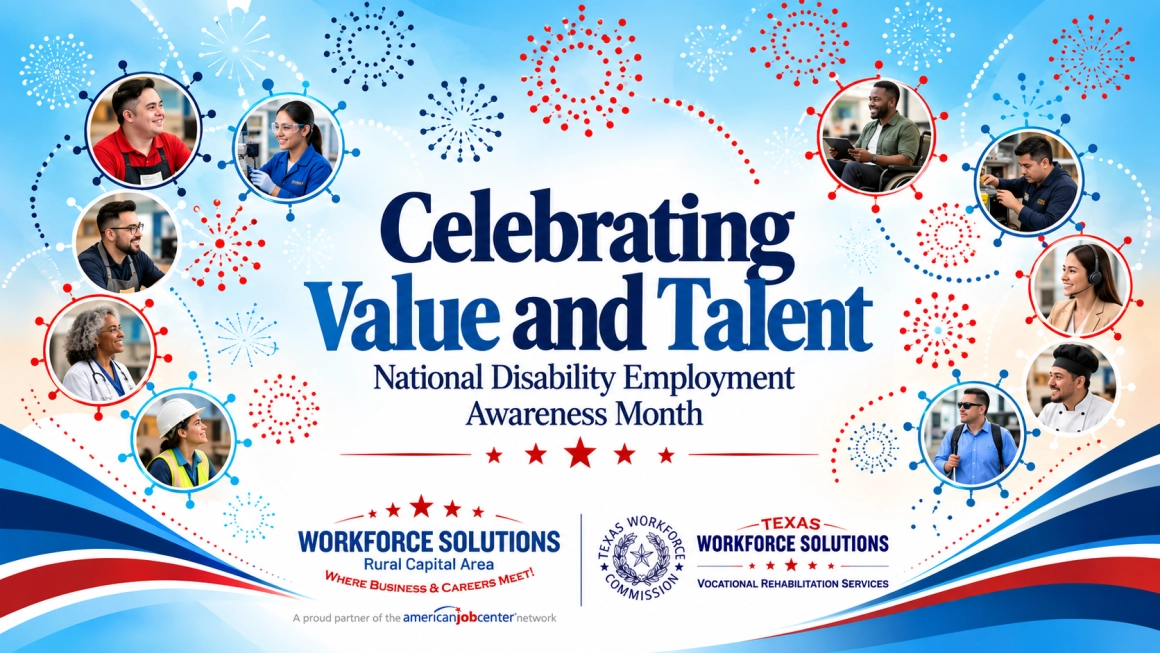
October is National Disability Employment Awareness Month, or NDEAM, but the conversation is really about something much bigger than a month on the calendar.
It’s about talent, opportunity and making sure people have the chance to show what they can do.
At Workforce Solutions Rural Capital Area (WSRCA), that work is part of what we do every day. We’re proud to work alongside Texas Workforce Solutions-Vocational Rehabilitation Services, part of the Texas Workforce Commission, to help connect Texans with disabilities to employment opportunities and help employers recognize, recruit and retain talent.
Because disability is something that can touch any of our lives.
More than 1 in 4 adults in the United States has some type of disability, according to the Centers for Disease Control and Prevention. And just over 1 in 4 of today’s 20-year-olds is expected to become disabled before reaching retirement age, according to a federal Consumer Financial Protection Bureau resource citing Social Security Administration data.
Some people are born with disabilities. Others acquire them through an injury, illness or health condition, or as they age. Some disabilities are visible. Many aren’t.
That’s why disability employment isn’t an issue affecting some distant group of people. It touches our families, our workplaces and our communities. At some point in our lives, it could affect any one of us.
And for employers looking for talented people, it represents an important part of our workforce that can’t be overlooked.
More Than 80 Years of Recognizing Talent
NDEAM has roots stretching back more than 80 years.
The observance began in 1945 as a week dedicated to recognizing the contributions of workers with physical disabilities. In 1988, Congress expanded the observance to the full month of October and broadened its focus to recognize the importance of increasing employment opportunities for people with disabilities.
That evolution matters.
Today, NDEAM recognizes people with disabilities across the workforce, including people with mental health conditions and other disabilities that may not be obvious to the people around them.
Since 2001, the U.S. Department of Labor’s Office of Disability Employment Policy has led NDEAM, including the selection and promotion of its annual theme.
For 2026, that theme is “Celebrating Value and Talent,” recognizing the skills and contributions Americans with disabilities bring to our workplaces, communities and economy. This year’s observance also coincides with America’s 250th birthday and the U.S. Department of Labor’s year-long recognition of the American worker.
For WSRCA, that message gets right to the heart of workforce development.
Why This Matters
Employers across our region are looking for talent.
At the same time, talented people continue to encounter barriers to employment because workplaces, hiring practices or perceptions haven’t always caught up with what they can do.
The numbers show there’s still a significant gap.
According to the U.S. Bureau of Labor Statistics, 22.8 percent of people with disabilities were employed in 2025, compared with 65.2 percent of people without disabilities. Among working-age adults ages 16 to 64, the labor force participation rate was 41.8 percent for people with disabilities, compared with 78 percent for people without disabilities.
Those numbers don’t tell us what people are capable of.
They tell us there’s still work to do connecting talent with opportunity.
And for employers, that should get our attention.
Expanding who gets considered for a job can mean reaching skilled, motivated candidates who may have been overlooked by traditional recruiting and hiring practices.
This isn’t about hiring someone because they have a disability. It’s about making sure a disability isn’t the reason a qualified person never gets the opportunity to show what they can do.
That’s also where partnerships matter. Through the statewide Texas Workforce Solutions system and Vocational Rehabilitation Services, employers can access expertise and resources to help recruit, hire, accommodate and retain people with disabilities. Job seekers can receive individualized services designed to help them prepare for, obtain, maintain and advance in employment.
Connecting those two sides is good workforce development.
Disability Doesn’t Look Just One Way
One of the most important things to understand about disability is that we can’t always see it.
Some disabilities are apparent. A person may use a wheelchair, prosthetic or another mobility device. Someone may be blind, have low vision, be deaf or hard of hearing.
But many disabilities are nonapparent.
A coworker, customer or job applicant may have a mental health condition, neurological disability, chronic health condition or another disability that isn’t immediately visible.
You may work alongside someone with a disability every day and never know it.
That’s an important reminder for all of us. We don’t always know what someone else is navigating, and we shouldn’t make assumptions about what a person can or can’t accomplish based on a disability.
There’s no single picture of disability, just as there’s no single picture of talent.
How Employers Can Expand Opportunity
Creating a more inclusive workplace doesn’t always require a major program or a complete overhaul of how an organization operates.
Sometimes it starts with asking better questions.
Are job descriptions focused on what someone actually needs to accomplish? Are applications and interviews accessible? Are we making assumptions about what someone can or can’t do? Do employees know they can ask for an accommodation? Are supervisors prepared to have those conversations?
Most importantly, are we looking at a candidate’s abilities before focusing on their disability?
Small changes in recruiting, interviewing, onboarding and workplace practices can remove barriers that have little to do with whether someone can actually perform a job.
And when those barriers come down, employers can gain access to talent they might otherwise have missed.
Employers don’t have to navigate that work alone. WSRCA and our Texas Workforce Solutions partners can help businesses understand available resources and connect with Vocational Rehabilitation Services and other support that can help turn the goal of inclusive employment into an everyday workforce practice.
What Happens When We Expand Opportunity
When employers widen the door, they widen their talent pool.
They also send an important message to their entire workforce: Your value here is based on what you contribute.
That matters to someone applying for their first job. It matters to a worker who acquires a disability midway through a career. And it matters to an experienced employee who may need an accommodation to continue doing work they’ve successfully performed for years.
Inclusive employment isn’t just about bringing new people into the workforce. It can also be about keeping talented people in it.
It means recognizing skills, experience and potential and then asking what someone needs to succeed.
For WSRCA, our role is to help make those connections possible by working with job seekers, employers, Texas Workforce Solutions-Vocational Rehabilitation Services and community partners to identify barriers, connect people with resources and create pathways to employment.
This October, We’re Sharing Their Stories
Throughout National Disability Employment Awareness Month, we’re going to introduce you to employers across the Rural Capital Area that have made a commitment to expanding their workforce and creating opportunities for people with disabilities.
We want to show what inclusion looks like in an actual workplace.
You’ll meet employers who looked beyond assumptions and saw talent. We’ll share why they made that commitment, what they’ve learned and how their employees have contributed to their organizations.
Because these aren’t stories about charity.
They’re stories about people going to work, learning new skills, contributing to a team, earning a paycheck and building a future.
They’re also stories about employers discovering talent they might otherwise have missed.
And we’re proud to tell those stories alongside our partners at Texas Workforce Solutions-Vocational Rehabilitation Services, who work every day to help Texans with disabilities prepare for, find and succeed in employment.
Celebrating Talent Means Creating Opportunity
When we remove unnecessary barriers, we don’t lower expectations.
We give more people the opportunity to meet them.
That’s ultimately what National Disability Employment Awareness Month is about: recognizing the value and talent people with disabilities already bring to our workforce while continuing to create workplaces where more people have the opportunity to contribute.
After more than 80 years of recognizing the contributions of people with disabilities to America’s workforce, there’s still work ahead.
And throughout October, we’re looking forward to introducing you to some of the employers and employees across our region who are showing us what’s possible when talent and opportunity connect.