
40 Years of Opportunity: WSRCA Begins a Yearlong Celebration

Posted by: Brian Hernandez
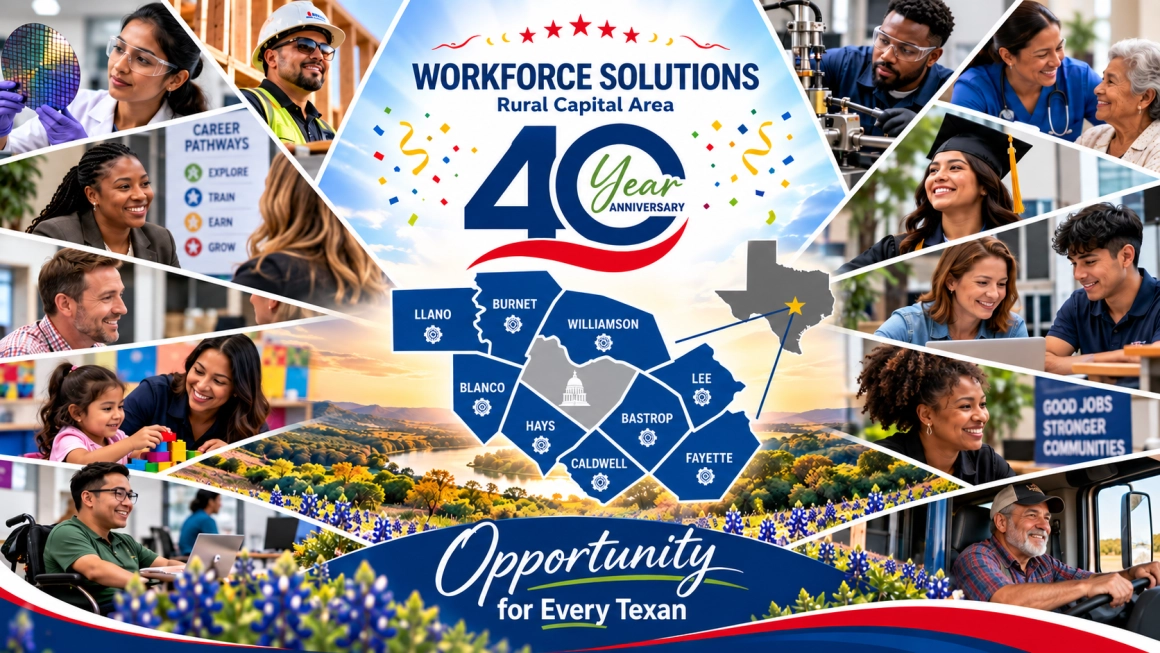
A lot can change in 40 years. Communities grow, industries rise and transform, technology reshapes how we work, and careers that once didn't exist become some of the most important jobs in our economy.
In 2027, Workforce Solutions Rural Capital Area (WSRCA) will celebrate 40 years since the organization that became today's WSRCA was incorporated in 1987. It's a milestone we're incredibly proud of, but our story didn't suddenly begin with a certificate of incorporation. The roots of workforce development in our region reach even further back through earlier federal workforce programs, local partnerships and a model built around a simple idea that still guides our work today: the people who create jobs should have a meaningful voice in preparing people for those jobs.
As we begin our 40th anniversary celebration, we're looking back at how that system developed, the people and partnerships that built it, and what four decades of change can teach us about preparing the Rural Capital Area for whatever comes next. We're incredibly grateful for the public investment and community trust that have made this work possible, but an anniversary is also an opportunity to look forward. Our region isn't standing still, and neither can we.
Our Story Didn't Begin With a Name
Before Workforce Solutions, before the Texas Workforce Commission (TWC) and before today's network of 28 Local Workforce Development Boards, communities were already working to connect people with jobs and training.
During the 1970s and early 1980s, federal workforce programs operated under the Comprehensive Employment and Training Act, commonly known as CETA. The system changed significantly after Congress passed the Job Training Partnership Act in 1982, which created local Service Delivery Areas and Private Industry Councils, commonly called PICs. These councils brought employers and community leaders into decisions about how employment and training resources were used locally.
Here in Central Texas, that included the Rural Capital Area Private Industry Council. Historical records show the Council was operating by at least 1985, overseeing workforce services in communities surrounding Travis County and participating in the newly formed Texas Association of Private Industry Councils. By 1987, local newspaper accounts were documenting Job Training Partnership Act employment programs operating under its guidance.
That year also brought an important milestone. On June 30, 1987, the organization associated with today's WSRCA was formally incorporated as a Texas nonprofit, with federal records showing its tax-exempt status following in 1988.
That's the milestone we'll officially commemorate with our 40th anniversary in 2027, but it's part of a much longer story. For decades, employers, elected officials, educators, community organizations and workforce professionals across this region have worked together to solve problems that no single organization could solve alone.
That spirit of partnership has carried forward even as the workforce system itself has changed dramatically.
Texas Builds a Different Kind of Workforce System
The next major chapter came during the 1990s, when Texas began fundamentally reorganizing the way workforce programs were delivered. Before that transformation, employment, training and related services could be spread across different programs and government agencies.
In 1995, the Texas Legislature created TWC and brought 28 workforce development programs from 10 different state agencies into a more integrated system. Rather than concentrating all of those decisions at the state level, Texas established a model in which 28 Local Workforce Development Boards would take responsibility for strategic planning and oversight within their regions.
Texas also connected workforce development and child care within the same system, recognizing a relationship that remains central to our work today.
There is no workforce without child care.
A parent can have the skills an employer needs, an employer can have the job available and a training program can offer a pathway to a better career, but if that parent doesn't have safe, reliable and affordable care for their child, that opportunity may remain out of reach.
Bringing those responsibilities together allows Texas' workforce system to look beyond whether a job exists and consider what people need to actually participate in the workforce. It also allows local workforce boards to work with families, employers and child care providers as interconnected parts of the same regional economy.
That local structure matters because economies and family needs aren't identical from one community to another. The workforce and child care needs of a rapidly growing community in Williamson or Hays County won't always look like those of a rural community in Llano, Fayette or Lee County. A regional system gives us the ability to understand those differences while connecting our communities to the resources and reach of a coordinated statewide network.
The term "workforce" is used by many organizations today, but Texas Workforce Solutions has a specific role in our state. It's the public workforce system that connects state resources with local leadership, bringing together TWC, 28 Local Workforce Development Boards, service providers, employers and community partners.
Here in the Rural Capital Area, WSRCA is the only local workforce development board certified by the State of Texas to oversee and guide workforce development services across Bastrop, Blanco, Burnet, Caldwell, Fayette, Hays, Lee, Llano and Williamson counties. That responsibility goes well beyond providing individual programs or services. We help set regional workforce priorities, direct investments, bring employers and community partners together, and make sure the public workforce system responds to the different needs of people, families, businesses and communities across our nine counties.
What Does Employer-Led Actually Mean?
It's easy to call a workforce system "employer-driven." What's more important is what that means for the people and communities it serves.
By law, at least 51% of a Texas local workforce board must represent private-sector employers, and the Board Chair must also come from the private sector. Those employers serve alongside representatives from education, labor, economic development, community organizations, government and other workforce partners.
That structure is intentional because workforce development works best when training isn't happening in isolation from the jobs it's supposed to lead to. Employers can tell us what positions they're struggling to fill, which skills are becoming more important, how technology is changing their workplaces and where they see their industries heading. Educators can help translate those needs into learning and credentials, economic development partners can help identify where investment and growth are occurring, and community organizations can help us understand the barriers that may prevent people from reaching those opportunities.
Our job is to help connect those pieces and turn them into results.
That's why local labor market information matters. It's why WSRCA identifies target occupations and works with employers and educators to build training around real demand. It's why Registered Apprenticeships and other earn-and-learn models are so valuable, and why career exploration should begin before someone is standing in a Workforce Center looking for their next job.
It's also why workforce development can't be limited to helping someone write a résumé or complete a training program. Sometimes the biggest obstacle between a person and a job isn't a lack of skills. It's a barrier that makes going to work difficult in the first place.
For thousands of working families, that barrier is child care.
There Is No Workforce Without Child Care
For many families, child care is what makes employment possible. It's what allows a parent to accept a job, stay employed, attend school, complete workforce training or pursue a promotion that could improve the future of their family.
That's why Child Care Services are such an important part of the workforce system WSRCA oversees.
Through Early Learning Tuition Scholarships, WSRCA helps eligible families afford quality child care while parents work, attend school or participate in workforce training. In 2025 alone, we supported 3,289 families and helped 4,641 children access early learning opportunities across the Rural Capital Area.
Those numbers tell only part of the story. Behind them are parents who could go to work knowing their children had a safe place to learn and grow, employers that could retain valuable members of their workforce, and families that gained greater stability because one of the biggest barriers to employment became more manageable.
Our work doesn't stop with helping families afford care. We also work with the child care providers that families and employers depend on every day. In 2025, WSRCA partnered with 318 providers across our nine counties, helping strengthen an early learning network that is an essential part of our regional economy.
Through Texas Rising Star, Texas' quality rating and improvement system, we work alongside child care providers as they strengthen their programs and the learning environments they create for children. That support helps providers continue improving quality while giving families greater access to early learning environments where children can develop, explore and prepare for school.
That's important because child care isn't simply about having a place for children to go while their parents work. Quality early learning helps children develop communication, problem-solving, social and emotional skills, confidence and curiosity. These are foundations they'll carry into kindergarten, through school and eventually into the workforce themselves.
In that sense, early learning works in two directions at once. It supports the workforce our employers need today while helping build the foundation for the workforce our communities will need tomorrow.
We often describe roads, utilities, transportation and broadband as economic infrastructure because businesses and communities depend on them to function. Child care belongs in that conversation. Employers can't build a reliable workforce if parents can't find reliable care, and communities can't fully benefit from economic growth if families can't participate in the opportunities that growth creates.
For WSRCA, helping families access early learning and helping providers strengthen quality aren't separate from our workforce mission. They're fundamental to it.
Forty Years of Change
That broader understanding of workforce development is just one example of how much this work has changed since 1987.
Four decades ago, there was no online job search, virtual career fair or smartphone giving someone immediate access to thousands of openings. Artificial intelligence wasn't reshaping occupations, and many of the careers driving today's Central Texas economy either looked completely different or didn't exist.
Today, someone can explore careers from a phone, earn an industry-recognized credential, participate in a virtual hiring event or enter a Registered Apprenticeship that combines paid work with training. Employers can reach potential workers across communities almost instantly, even as they compete for increasingly specialized talent.
WSRCA has evolved right along with that workforce. Today, we help employers recruit, train and retain talent while helping people explore careers, find jobs and access education and training. We help families access Early Learning Tuition Scholarships so parents can work or prepare for their next career, and we work alongside child care providers through Texas Rising Star. We're reaching students earlier so they can understand how what they're learning today connects with opportunities around them.
We're also finding new ways to bring opportunity closer to where people live. Career Ready Central Texas gives students, families, educators and job seekers across a 10-county region a central place to explore careers, education and training opportunities. Our partnership with American YouthWorks is expanding YouthBuild opportunities into Taylor, Lockhart and surrounding communities, bringing education, hands-on training and career pathways closer to young people in rural Central Texas.
The technology, programs and terminology would probably look unfamiliar to the people who served on the Rural Capital Area Private Industry Council four decades ago.
The purpose wouldn't.
Forty Years Is Really Thousands of Stories
An anniversary like this can be measured in years, programs, investments and statistics, but that's not really where our history lives. It lives in the thousands of people, families, employers and partners who've been part of this work.
It's the person who came to a Workforce Center looking for a job and discovered a career path they hadn't considered, the student who learned about an occupation they didn't know existed, the worker who earned a credential or began an apprenticeship, and the employer that found the talent it needed to grow.
It's also the parent who could accept a job, begin training or pursue a promotion because an Early Learning Tuition Scholarship made child care affordable. It's the child who spent those same hours learning and growing in a quality early learning environment, and it's the child care provider working to strengthen its program and serve more families.
Those stories are connected because people don't experience workforce challenges one program at a time. A person may need training, but they may also need child care. An employer may need workers, but it may also need help developing a talent pipeline. A student may need career information, but what can really change their future is meeting an employer, experiencing a workplace or seeing a pathway that suddenly feels possible.
That's why our work continues to evolve toward connecting services, investments, partners and opportunities rather than simply delivering individual programs.
We're incredibly grateful to the generations of community leaders who've helped make that possible. From the early members of the Rural Capital Area Private Industry Council to the volunteer leaders serving on WSRCA's Board of Directors today, people have generously given their time, expertise and relationships to strengthen workforce development across this region.
Our Board members don't simply lend their names to an organization. They bring the perspectives of employers, workers, educators and communities to the table, helping us stay connected to what's actually happening across our nine counties. That local leadership has been one of our greatest strengths for four decades, and it will become even more important as we think about what comes next.
The Next Chapter Will Require New Ideas
Forty years gives us plenty to celebrate, but we're much more interested in what those 40 years have prepared us to do next.
Our workforce system is entering another period of significant change. Technology is moving quickly, industries are evolving, skills are changing and communities across the Rural Capital Area continue to grow. Employers need new kinds of talent, families are navigating new challenges and the cost of delivering many services continues to increase.
At the same time, public resources are limited. Federal and state funding have made an extraordinary amount of this work possible, and we're deeply grateful for every public dollar entrusted to our region. Our responsibility is to be good stewards of those investments and turn them into meaningful results for the people, employers and communities we serve.
But responsible stewardship also means thinking beyond the next grant or funding cycle.
The workforce challenges facing our region are too important and too complex to expect public funding alone to solve them. That's why one of the biggest opportunities in our next chapter is diversifying the resources behind this work and bringing more private industry, philanthropy, education, economic development and community investment to the table.
For us, diversifying funding isn't simply about finding more money. It's about creating a stronger, more resilient workforce system and giving more partners a meaningful stake in its success.
Employers already help guide our strategy. Increasingly, we want to explore how businesses can also become investment partners in solutions that directly affect their ability to recruit and retain workers. That could mean helping develop talent pipelines, expanding Registered Apprenticeships, introducing students to careers, bringing training into rural communities or investing in child care solutions that help parents remain in the workforce.
Child care may be one of the clearest examples of why that broader partnership is necessary. Employers have a direct stake in whether their employees can find dependable care. Providers need resources to strengthen quality and capacity. Families need affordable options, and communities need enough care to support economic growth. Public funding provides an essential foundation, but employers, philanthropy and community partners can help us think differently about how we build capacity, test solutions and close gaps that traditional funding can't always address.
Philanthropic partners can bring another dimension by helping communities test innovative ideas, reach populations that may otherwise be difficult to serve and invest in promising approaches that don't always fit neatly within existing public funding streams. Educational institutions, economic development organizations, foundations, nonprofits and other community partners bring expertise, resources and relationships that can multiply the impact of the public investment already being made.
That's the kind of innovation we're focused on.
Innovation doesn't always mean creating another program. Sometimes it means connecting resources differently, using technology to reach someone we couldn't reach before, bringing training to a community instead of asking people to travel to it, giving an employer a new way to invest in its future workforce or bringing partners together around a problem none of us could solve alone.
After 40 years, our role is increasingly about making those connections happen and turning them into measurable results.
Looking Back to Build What's Next
Over the coming months, we're going to open the archives and tell more of this story. We'll revisit milestones from our history, introduce some of the people who helped shape workforce development across the Rural Capital Area and share stories from employers, workers, families, child care providers and community partners whose paths have intersected with WSRCA during the past four decades.
We'll look forward, too, because a 40th anniversary shouldn't only be about where we've been.
Advanced manufacturing, healthcare, skilled trades, construction, technology and other industries are creating new possibilities across Central Texas. Artificial intelligence and automation are changing how work gets done. Employers are looking for new skills, while young people are entering a workforce with more possible pathways than generations before them.
Families need access to child care that allows parents to participate in those opportunities. Child care providers need partners as they strengthen the early learning environments our communities depend on. Students need earlier exposure to careers, workers need opportunities to continually build new skills, employers need stronger talent pipelines, and our rural communities need solutions that bring opportunity closer to home.
Meeting those challenges will require us to keep doing what this region has done for decades: bring the right people together, listen to what our communities and employers are telling us, use our resources responsibly and be willing to try something new when the old approach isn't enough.
We're deeply grateful for the public investments that have allowed us to serve this region and for the employers, educators, elected officials, community organizations, child care providers, families and workforce professionals who've trusted us to be part of their work.
The best way we can honor that trust isn't simply by celebrating what we've accomplished. It's by continuing to deliver results, finding new partners, attracting new investment and building a workforce system that's ready for the next 40 years.
If WSRCA, one of our Workforce Centers, Child Care Services or one of the programs and organizations that came before us has been part of your career, your business, your family or your community, we want to hear your story as we celebrate this milestone.
Because after 40 years, our history isn't really the story of an organization. It's the story of a region that keeps changing and the people who keep working together to make sure opportunity keeps pace.
That's the work we've inherited from those who came before us. Now it's our responsibility to build on it, find new partners, create new solutions and make sure the next generation has even more opportunities than the one before it.
Here's to 40 years of opportunity, and to what we build together next.