
Manufacturing Month: Building More Than Products
Posted by: Brian Hernandez
Manufacturing Day may have been Friday, but one day really isn’t enough.
That’s why Workforce Solutions Rural Capital Area (WSRCA) is proud to celebrate Manufacturing Month throughout October. Across our nine-county region, manufacturing is creating careers, supporting families, driving innovation and helping communities of every size prepare for what comes next.
When we talk about manufacturing, it’s easy to think first about the things being made. But the bigger story is about the people making them, the businesses supporting them and the communities growing around them.
And here in the Rural Capital Area, that story is getting bigger.
Manufacturing Is a Major Part of Our Economy
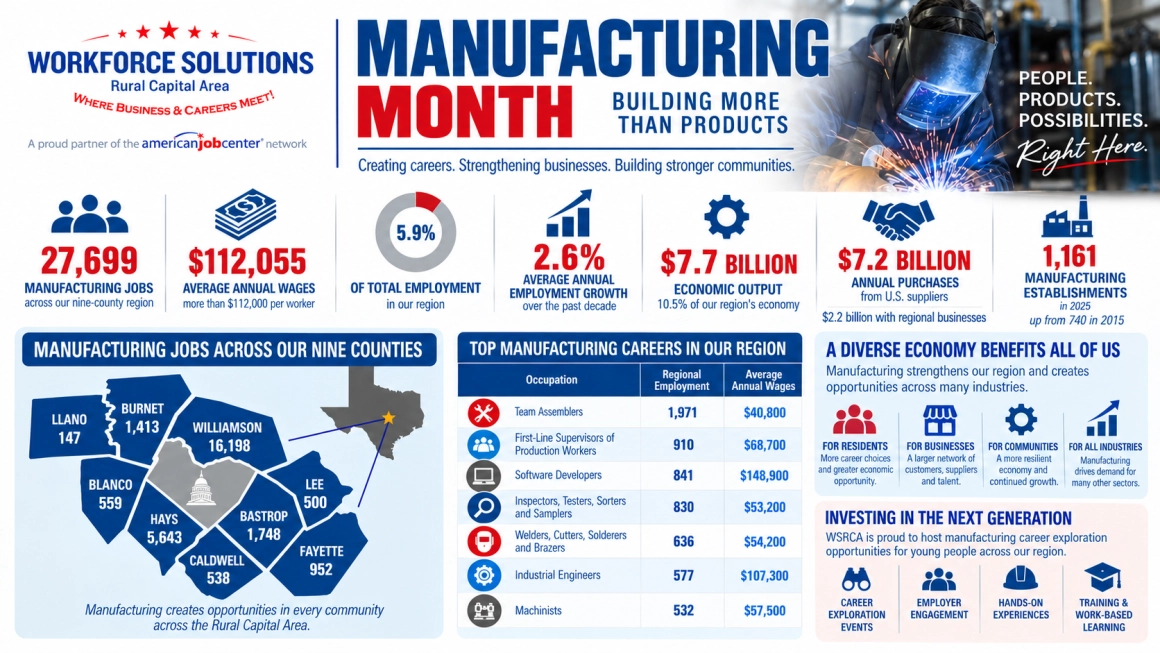
Nearly 27,700 people work in manufacturing across Bastrop, Blanco, Burnet, Caldwell, Fayette, Hays, Lee, Llano and Williamson counties. Manufacturing accounts for about 5.9% of employment in our region, with average annual wages across the industry of more than $112,000.
Those jobs reach every county we serve. Williamson County has more than 16,000 manufacturing jobs and Hays County has more than 5,600, while Bastrop has nearly 1,750, Burnet more than 1,400 and hundreds more are found across Fayette, Blanco, Caldwell, Lee and Llano counties.
But why should that matter to someone who doesn’t work in manufacturing?
Because a strong economy needs more than one engine.
Industry diversity gives our communities more ways to grow and adapt. Manufacturing is part of an economy that also includes health care, education, construction, technology, retail, hospitality, professional services and many other industries. Having that mix means our region isn’t dependent on one type of employer or one source of jobs.
For residents, that means more choices. For businesses, it means a larger network of customers, suppliers and talent. And for communities, it means a broader economic foundation for supporting schools, local businesses, services and future growth.
So even if you never work in manufacturing, manufacturing is still working in your community.
What Happens Inside a Plant Doesn’t Stay There
In 2025, manufacturing generated an estimated $7.7 billion in economic output across the Rural Capital Area, accounting for 10.5% of our region’s total economic output. Manufacturing output also grew at an average annual rate of 5.9% over the previous decade.
That economic activity doesn’t stop at the factory door.
Manufacturers in our region make an estimated $7.2 billion in annual purchases from suppliers across the country, and about $2.2 billion of that spending stays right here with businesses in the Rural Capital Area.
Think about what that means locally.
A manufacturer grows and needs more equipment. It may need additional electrical work, transportation, warehousing, engineering, technology support, construction, maintenance or professional services. Those businesses may need additional employees. Those workers earn paychecks and spend money in their communities.
A manufacturing paycheck does the same thing. It becomes a mortgage or rent payment, groceries, child care, transportation, dinner at a local restaurant or a purchase from a neighborhood business.
That’s how the impact spreads.
Growth in manufacturing can help create opportunity in industries that may seem completely unrelated to manufacturing.
More Businesses Are Choosing to Make Things Here
Our manufacturing base isn’t just large. It’s been growing.
In 2015, the Rural Capital Area had 740 manufacturing establishments. By 2025, that number had climbed to 1,161, an increase of more than 400 locations in a decade.
Over the 10 years ending in 2025, the region also added more than 6,200 manufacturing jobs.
That growth gives our residents something incredibly valuable: more ways to build a career without having to follow the same path as everyone else.
A healthy regional economy needs entry points for someone beginning a career, opportunities for experienced workers looking to advance, technical careers for people who enjoy working with their hands and technology, and professional careers for those pursuing engineering, business, computer science and other fields.
Modern manufacturing offers all of those.
Today’s Manufacturing Career Might Surprise You
There’s another reason Manufacturing Month matters. It gives us an opportunity to challenge some outdated ideas about what manufacturing looks like.
Yes, manufacturers still need people who can weld, assemble, machine, maintain and operate equipment. Those skills are incredibly valuable.
But walk into a modern manufacturing operation and you may also find software developers, engineers, managers, logistics professionals, technicians, information technology specialists, sales professionals and many others.
Our regional manufacturing workforce includes nearly 2,000 team assemblers, more than 900 production supervisors, 841 software developers, 830 inspectors and testers, 636 welders, 577 industrial engineers and 532 machinists.
The career and wage possibilities are just as varied. Software developers working in manufacturing average about $148,900 annually, industrial engineers about $107,300, industrial machinery mechanics $64,500, machinists $57,500 and welders about $54,200.
And the mix continues to evolve. Semiconductor processing technicians, mechanical and electrical engineers, computer hardware engineers and other highly technical occupations are already part of our regional manufacturing workforce.
Modern manufacturing isn’t just about making something. It’s about designing it, programming it, testing it, maintaining it, improving it and getting it where it needs to go.
You Can’t Choose a Career You’ve Never Seen
That’s why WSRCA is proud to host manufacturing career exploration opportunities for young people across our region.
We can talk to students about careers all day, but there’s something different about giving them an opportunity to see the work, meet the people doing it and experience it for themselves.
Working alongside schools, employers and community partners, we’re helping students explore manufacturing through career events, employer engagement, career coaching, hands-on experiences and connections to work-based learning and training.
A student who loves computers may never realize there’s a place for them in manufacturing until they meet a software developer working for a manufacturer. A student who enjoys solving problems may discover engineering. Someone who likes working with their hands may find welding, machining or industrial maintenance. Another student may become fascinated by semiconductors, electronics or automation.
That’s the point.
We’re not trying to tell every young person which career to choose. We want them to understand how many choices they actually have.
And there isn’t one pathway into manufacturing.
For one student, the next step may be career and technical education in high school. For another, it could be an industry credential, apprenticeship or technical training. Someone else may continue to a two-year or four-year college and pursue engineering, computer science, business or another field.
Our job is to help make those possibilities visible and connect people with the pathways that can get them there.
We Need to Build the Workforce Before We Need It
Our regional data points to continued manufacturing growth, with nearly 3,500 workers needed annually when both new employment and the need to replace workers leaving occupations are considered.
That doesn’t mean 3,500 entirely new jobs every year. Employers also need people when experienced workers retire, change occupations or otherwise leave jobs that still need to be filled.
That’s an important distinction because it shows why workforce development can’t begin when an employer posts a job opening.
It starts years earlier.
It starts when a middle or high school student gets to tour a manufacturing facility and discovers a career they didn’t know existed. It continues when a student chooses a career and technical education program, when someone earns an industry credential, when an apprentice learns from an experienced worker or when an adult comes back for training to build new skills.
Employers need that pipeline. Residents need those pathways. Our communities benefit when the two connect.
And none of it happens through the work of one organization.
It takes employers willing to open their doors and share what they need. It takes educators connecting classroom learning with careers. It takes training providers, economic development organizations, chambers and community partners working together. And it takes workforce organizations like WSRCA helping connect those pieces.
A Stronger Mix Makes a Stronger Region
Perhaps the biggest reason to celebrate Manufacturing Month is what manufacturing adds to the larger economic story of our nine counties.
We don’t want our communities dependent on one employer, one occupation or one industry.
We want an economy with many doors into opportunity.
Manufacturing helps provide that diversity. It creates opportunities for someone with a high school diploma, someone earning an industry credential, someone completing an apprenticeship and someone graduating with an engineering or computer science degree.
It also strengthens the industries around it.
A growing manufacturer can mean more work for a local construction company, more freight for a transportation provider, more business for an accountant or technology company and more customers walking through the doors of restaurants, retailers and other small businesses.
That diversity can also make our region better prepared for change. Industries will continue to evolve. Technology will continue to reshape jobs. Some occupations will grow while others change.
The more skills, employers and industries our communities have, the more opportunities residents have to adapt along with them.
That matters whether you’re a student deciding what comes next, a parent hoping your child can find opportunity close to home, a worker thinking about your next career move, a small business owner looking for customers or an employer trying to grow.
A more diverse economy gives all of us more ways to succeed.
Celebrating What Manufacturing Makes Possible
Manufacturing Month gives us a chance to celebrate some pretty incredible things being made across Central Texas.
But for WSRCA, the celebration is about much more than what comes off an assembly line.
It’s about the welder building a career close to home. The technician mastering new technology. The engineer solving a problem. The software developer helping operate a modern facility. The small business gaining a new customer. The employer investing in a community. And the student walking into a manufacturing environment for the first time and realizing, “I could do that.”
That’s why we’re proud to celebrate Manufacturing Month, and why we’re proud to help more people experience what this industry has to offer.
Because manufacturing doesn’t just make products.
It helps make careers possible, families stronger, businesses more competitive and our economy more diverse.
And when manufacturing grows alongside all of the other industries that make the Rural Capital Area strong, our entire region has more opportunities to grow with it.