
What’s the Fastest Way to $100K in Central Texas?

Posted by: Brian Hernandez
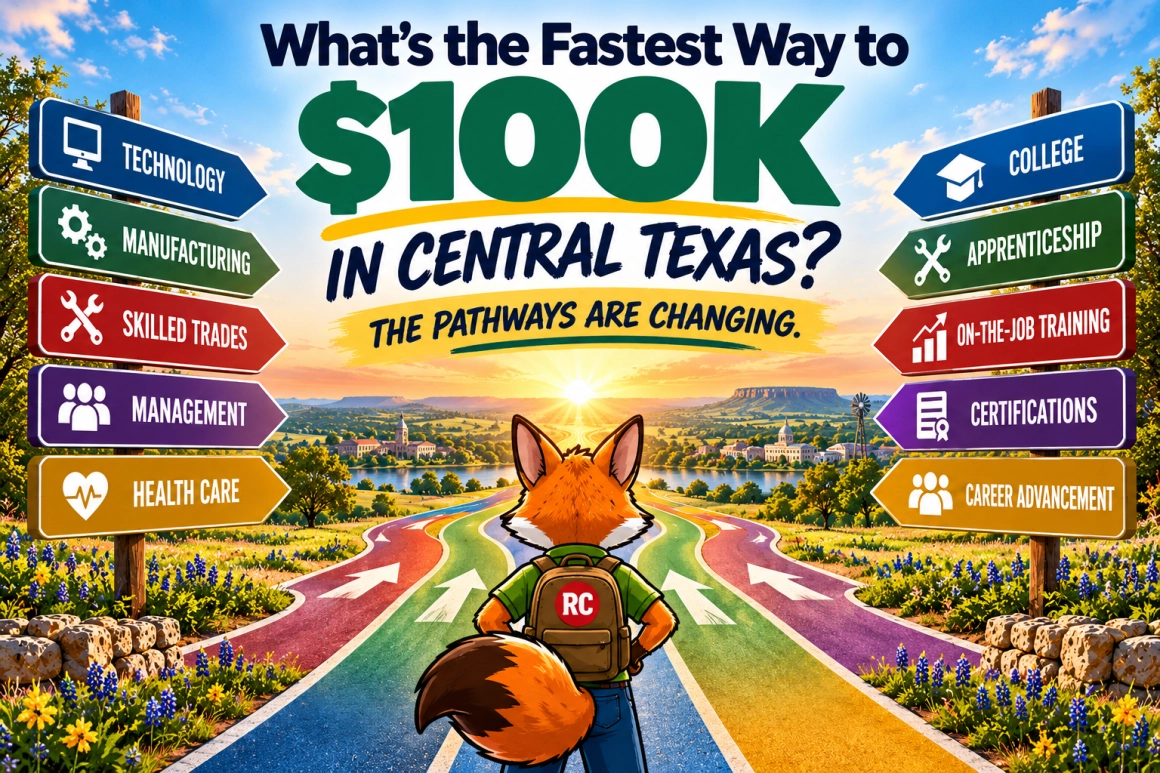
Want to make $100,000 a year?
Of course you do.
But here’s the more interesting question: How do you get there?
For years, the road to a six-figure career seemed pretty straightforward. Go to college, earn a degree, land a good job, work your way up and eventually crack $100,000.
That path still works. But it’s definitely not the only one.
Across the nine-county Rural Capital Area, there are several career fields where average or experienced wages have already crossed the six-figure mark. Some require a college degree. Others reward technical skills, experience, leadership or a combination of all four.
So, what’s the fastest way to $100K in Central Texas?
There isn’t a cheat code. But there are some pretty interesting routes.
Why $100K?
Six figures has always had a certain ring to it. It sounds like a financial finish line.
But today, $100,000 can look a lot different depending on where you live, whether you have children and what your monthly expenses look like.
A 2026 SmartAsset analysis estimates that a single adult in the Austin area needs about $98,550 a year to live comfortably. Its definition of “comfortable” uses the 50/30/20 budgeting approach: 50% of after-tax income goes toward necessities, 30% toward wants and 20% toward savings or paying down debt. SmartAsset based its calculations on basic-needs data from the Massachusetts Institute of Technology (MIT) Living Wage Calculator.
That doesn’t mean everyone in Central Texas needs $100,000. Austin isn’t our entire region, and everyone’s circumstances are different.
The MIT Living Wage Calculator helps show just how much location and family size matter. It calculates the income needed to cover basic expenses such as housing, food, transportation, health care, child care and taxes, and provides estimates down to the county level.
There’s an important difference between those two ideas.
A living wage is about covering basic needs. A comfortable income leaves more room for savings, emergencies, paying down debt and enjoying life.
Suddenly, $100K doesn’t seem like such a random number.
So, which careers can get you there?
First, What Does a $100K Salary Really Mean?
Before we start picking careers, there’s something important to understand about wage data.
If a career has an average wage of $100,000, that doesn’t mean you’ll make $100,000 on your first day.
An average includes people at many different stages of their careers. Pay can vary based on experience, education, skills, employer and location.
Across all occupations in the Rural Capital Area, the average annual wage is $62,700. At the 90th percentile, wages reach $113,800.
That tells us something interesting.
Six figures isn’t limited to one or two careers, but getting there usually takes a plan.
Route No. 1: Computers and Technology
If technology is your thing, this is one of the clearest six-figure career fields in our region.
Computer and mathematical occupations average $112,600 annually in the Rural Capital Area. The median wage is $106,400, while experienced workers average $137,800.
There’s another reason to pay attention to this field: growth.
About 14,400 people currently work in computer and mathematical occupations across our region, with employment projected to grow 3.4% over the next year.
The catch?
You’ll need skills.
Technology careers can require very different combinations of education, certifications and experience. The fastest path isn’t necessarily collecting the most credentials. It’s figuring out which skills employers actually need and building from there.
Route No. 2: Engineering
Maybe you’d rather build the technology than code it.
Architecture and engineering occupations average $103,100 annually across our region. Experienced workers average $126,900, while workers at the 75th percentile earn $127,800.
These careers are growing, too. Nearly 6,900 people currently work in architecture and engineering occupations across the Rural Capital Area, with employment projected to grow about 3% over the next year.
Engineering is especially interesting because engineers don’t belong to just one industry.
They can help design a semiconductor facility, improve a manufacturing process, develop a product, build infrastructure or solve problems we haven’t even encountered yet.
Route No. 3: Move Up
Here’s one people sometimes overlook.
You don’t always have to completely change careers to increase your earning potential.
Sometimes the path is up.
Management occupations have an average annual wage of $127,400 in our region. Their median wage is $109,800, and experienced workers average $160,600.
And we’re not talking about a tiny corner of the workforce. More than 44,000 people work in management occupations across the Rural Capital Area.
Think about what that means for someone starting in manufacturing, construction, health care, logistics, finance or another industry.
Your first job doesn’t have to be your final destination.
Learning the work, building expertise, developing leadership skills and taking on more responsibility can create an entirely different earning path over time.
Route No. 4: Health Care
Health care gets interesting because it includes a huge range of careers.
Health care practitioner and technical occupations average $99,300 annually across our region. Experienced workers average $125,900, and wages at the 75th percentile reach $113,500.
That puts the field right on the doorstep of our $100K benchmark.
It’s also growing. Our region has more than 19,000 workers in these occupations, with employment projected to grow 3.1% over the next year.
Of course, “health care” can mean very different things. Training requirements for a technician aren’t the same as those for a registered nurse, therapist or physician.
That’s why the fastest route isn’t necessarily the career with the biggest paycheck.
You also have to factor in how long you’ll spend training before you can start earning one.
Here’s Where the Math Gets Interesting
Imagine two people who both want to reach $100K.
One chooses a career requiring several years of college before entering the workforce.
Another starts earning sooner through technical training, an apprenticeship or another career pathway and then works toward higher-skilled or leadership positions.
Who gets to $100K first?
There’s no universal answer.
And that’s exactly the point.
Salary alone doesn’t tell you the value of a career pathway.
You also have to consider how much training costs, how long it takes, whether you can earn while learning, how much debt you may take on and how much room the career gives you to advance.
Suddenly, “What’s the highest-paying job?” becomes a much more useful question:
What’s the best return on my time, training and talent?
Can You Reach $100K Without a Four-Year Degree?
Potentially, yes.
But we need to be careful with the word “fast.”
Broad career fields such as construction, installation and repair, production and transportation don’t currently average $100,000 in our region. Construction and extraction occupations, for example, average $53,600, while installation, maintenance and repair occupations average $58,600.
That doesn’t mean an individual worker can’t earn six figures.
It means we shouldn’t pretend $100K is the typical paycheck for everyone entering those careers.
For some workers, skilled trades and technical careers can become stepping stones into specialized positions, supervision, management or even business ownership.
Apprenticeship can also offer something especially valuable: the opportunity to earn while you learn instead of waiting until your education is finished to begin earning a paycheck.
That changes the math.
Don’t Pick a Career Because TikTok Told You To
Seriously.
A video telling you everybody in a particular trade makes $150,000 probably shouldn’t be the foundation of your career plan.
Neither should a post telling you that you absolutely need a certain college degree to succeed.
Look at the numbers. Look at the training required. Look at opportunities where you live. Talk to people doing the work. And whenever possible, experience the career for yourself.
Most importantly, think about what you’re good at and what kind of work you can actually see yourself doing.
Making $100K sounds great.
Making $100K in a career you hate can make for some very long Mondays.
So, What’s the Fastest Way to $100K?
Here’s the frustrating answer:
It depends.
Here’s the useful answer:
Start with the destination and work backward.
If $100,000 is your goal, look for careers with a realistic path to that level of earnings. Then compare the education, training, experience, demand and advancement opportunities required to get there.
Maybe your route runs through a university.
Maybe it’s technical training.
Maybe it’s an apprenticeship.
Maybe it’s starting in an entry-level position, becoming really good at what you do and moving into leadership.
Or maybe you’ll discover that the career that fits you best doesn’t pay $100,000 at all, but gives you the income, schedule, stability and life you actually want.
That’s worth considering too.
You Don’t Have to Figure It Out Alone
That’s where Workforce Solutions Rural Capital Area (WSRCA) comes in.
We help people across Bastrop, Blanco, Burnet, Caldwell, Fayette, Hays, Lee, Llano and Williamson counties explore careers, understand what employers need and connect with education, training and employment opportunities.
Because the goal isn’t simply to find a job with a big number attached to it.
It’s to find a pathway that makes sense for you.
And if $100K is the destination?
Let’s figure out how you might get there.