
Made in Central Texas: The $7.7 Billion Industry Powering Our Future

Posted by: Brian Hernandez
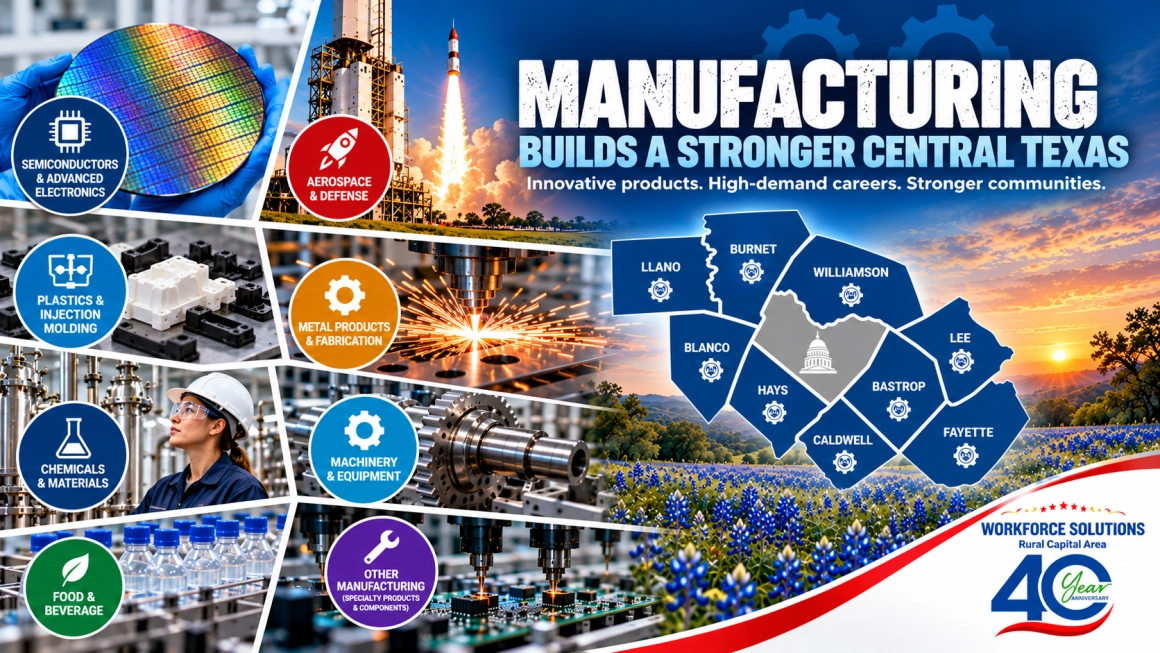
Manufacturing Month shines a light on an industry creating jobs, supporting local businesses and helping shape the future of Central Texas.
What does a $7.7 billion industry look like?
It looks like a rocket manufacturing facility in Caldwell County, a skilled technician in Hays County, a growing business in Bastrop County and thousands of workers across Central Texas making products that reach far beyond our communities.
And it's getting bigger.
This October, Manufacturing Month offers an opportunity to recognize an industry that's doing much more than making things. It's creating careers, strengthening local economies and helping position Central Texas for the next generation of growth.
According to new our economic reports, manufacturing contributed approximately $7.7 billion to the nine-county Rural Capital Area economy in 2025, accounting for 10.5% of the region's total economic output.
That's a remarkable contribution from an industry representing just 6% of regional employment.
And the numbers tell an even bigger story.
An Industry That's Growing and Paying Off
Manufacturing supports more than 28,000 jobs across Bastrop, Blanco, Burnet, Caldwell, Fayette, Hays, Lee, Llano and Williamson counties.
Over the decade ending in 2025, the industry added 6,268 jobs. The number of manufacturing establishments also grew from 740 in 2015 to 1,162 in 2025, an increase of 57%.
But perhaps one of the most compelling numbers is what manufacturing contributes to the people who work in it.
Average annual wages in the region's manufacturing sector reached $132,954 in the second quarter of 2026, compared with $71,562 across all regional industries.
That's about 86% higher than the regional average.
While wages vary significantly by occupation, employer and experience, the numbers illustrate the economic value manufacturing brings to Central Texas.
And there's more growth ahead.
Our data projects manufacturing employment will expand by approximately 3,700 jobs over the next five years, with thousands of additional opportunities expected as workers retire or move into other careers.
For communities looking to attract investment, strengthen their economies and create opportunities for residents, that's a story worth paying attention to.
Manufacturing Isn't Just Happening in One Place
Williamson County leads the region with nearly 16,500 manufacturing jobs, followed by Hays County with more than 5,700.
But manufacturing's reach extends well beyond the region's largest employment centers.
Bastrop County supports more than 1,700 manufacturing jobs, while Burnet County has nearly 1,500. Fayette, Blanco, Caldwell, Lee and Llano counties also contribute to the industry's regional footprint.
For smaller communities, manufacturing can mean more than jobs inside a single facility.
It can mean business for local suppliers, customers for nearby restaurants, demand for transportation services and opportunities for residents to build careers closer to home.
In fact, regional manufacturers are estimated to purchase approximately $2.2 billion in goods and services annually from other businesses within the nine-county region.
That's money flowing through local supply chains, supporting businesses and connecting manufacturing to the broader economy.
The Factory Floor Has Changed. So Have the Careers.
Forget the outdated picture of manufacturing as repetitive assembly-line work.
Today's manufacturing industry brings together skilled trades, engineering, software development, automation, quality control, business operations and advanced technology.
Consider the range of careers already supporting manufacturing across our region.
Our data estimates average annual wages of approximately $54,900 for welders, $58,100 for machinists, $108,100 for industrial engineers and $150,500 for software developers working in manufacturing.
These aren't all entry-level positions, and not every career requires the same education or training.
That's part of the opportunity.
Manufacturing offers multiple ways to enter the workforce and advance, from technical training and industry certifications to registered apprenticeships and college degrees.
It's also an industry where experience, problem-solving and the ability to learn new technologies can create opportunities for advancement.
For students considering their futures, adults exploring a career change and workers looking to build new skills, manufacturing deserves a closer look.
Central Texas Is Helping Build the Next Generation of Technology
One of the region's most promising manufacturing stories is happening in electronics and advanced technology.
According to our data, Central Texas' electrical and electronics manufacturing cluster supports approximately 9,386 jobs, with average annual wages exceeding $225,000.
That figure reflects the average across the cluster, including highly compensated technical and professional positions, rather than a typical starting salary.
The cluster also has more than twice the employment concentration expected nationally for a region of its size.
And its employment is projected to grow approximately 2.9% annually over the next decade.
These numbers help illustrate why advanced manufacturing, semiconductor-related production and the skills needed to support them are increasingly important to the region's economic future.
But they also raise an important question.
How do we make sure local residents are prepared to benefit from the industries growing around them?
Building the Workforce Behind the Growth
New facilities and expanding businesses create opportunities, but they also create demand for skilled workers.
That's where partnerships among employers, educators, workforce organizations and community leaders become essential.
Workforce Solutions Rural Capital Area (WSRCA) works with employers and regional partners to connect businesses with talent while helping job seekers explore training and career pathways.
That includes supporting registered apprenticeships, industry-recognized training and partnerships designed to prepare workers for the changing needs of local manufacturers.
The goal isn't simply to fill today's openings. It's to help build a workforce that can adapt as technology, equipment and industry needs continue to evolve.
And as manufacturing becomes more advanced, those connections will matter even more.
What's Next for Manufacturing in Central Texas?
The economic reports point to an industry with strong momentum, but the most interesting stories may be the ones behind the statistics.
How are smaller manufacturers finding ways to grow? What does a modern manufacturing career look like for a high school graduate? How are automation and artificial intelligence changing the skills employers need? And what happens to a community when a manufacturer invests, expands or creates new jobs?
Those are questions worth exploring because manufacturing's impact reaches far beyond the factory floor.
It reaches families building financial security, small businesses finding new customers and communities planning for the future.
During Manufacturing Month, we're celebrating the employers, workers, educators and community partners helping make that future possible.
Because what we're making in Central Texas isn't just products. We're making opportunity.
See the Reports:
Source: JobsEQ, Chmura Economics & Analytics, Manufacturing Industry Spotlight and Rural Capital Economic Overview, 2026. Employment and wage estimates reflect the second quarter of 2026; economic output and establishment figures reflect 2025. Employment forecasts are projections, not guaranteed job openings.