
40 Years of Change. One Mission That Still Matters.

Posted by: Brian Hernandez
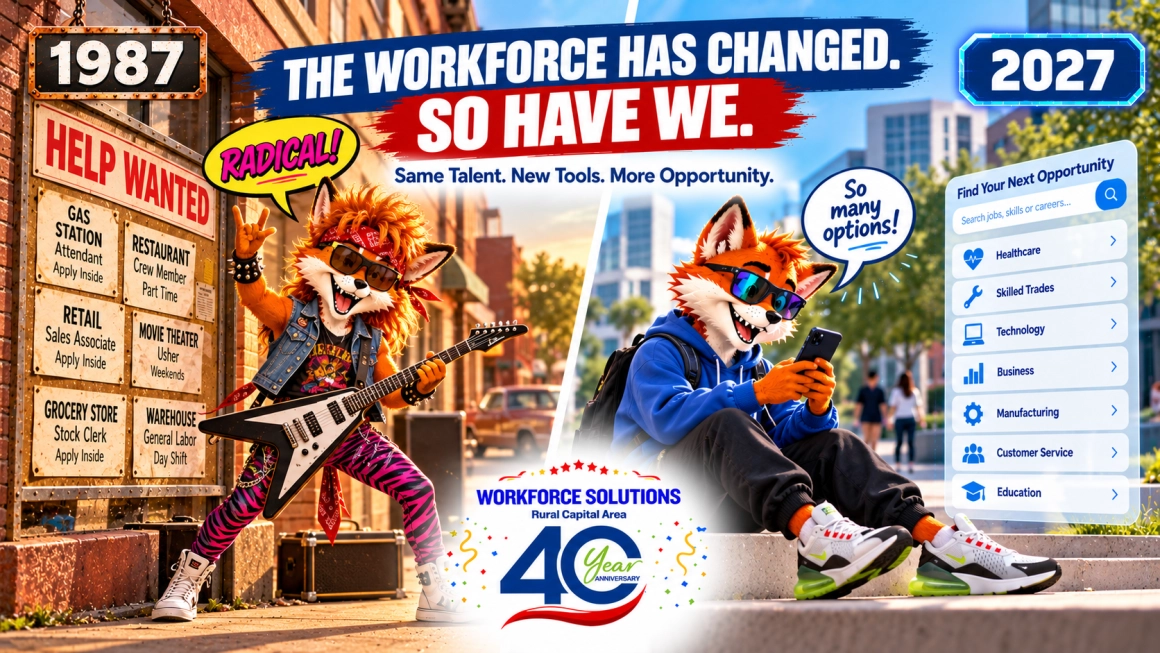
From newspaper classifieds to artificial intelligence, a look at four decades of changing careers, technology and opportunity in Central Texas.
Imagine looking for a job in 1987.
You might start by opening the newspaper to the classified ads, circling a few promising opportunities and picking up the phone to schedule an interview.
You'd probably type your résumé, print several copies and deliver applications in person. If you needed to learn a new skill, you might enroll in a classroom course or find an employer willing to train you.
Now fast-forward to 2026.
You can search thousands of jobs from your phone, interview over video, earn industry credentials online and use artificial intelligence (AI) to help prepare your résumé.
Meanwhile, robots are working alongside people in manufacturing facilities, healthcare professionals are using advanced digital tools and entirely new careers have emerged in industries that barely existed four decades ago.
A lot has changed.
And as Workforce Solutions Rural Capital Area (WSRCA) prepares to celebrate its 40th anniversary in 2027, we're reflecting on how much our workforce has evolved and how we've evolved right alongside it.
Remember When Finding a Job Meant Reading the Newspaper?
In the 1980s, finding employment often meant checking newspaper classifieds, visiting businesses in person or relying on word of mouth.
Employers advertised openings in print, collected paper applications and scheduled face-to-face interviews.
Job seekers couldn't instantly compare hundreds of opportunities or research a company with a few clicks.
And employers had fewer ways to reach qualified candidates beyond their immediate communities.
Today, technology has transformed that process.
Online job boards, digital applications, virtual interviews and professional networking platforms have made it possible to connect with employers almost anywhere.
But there's a catch.
More access to job openings doesn't always make finding the right job easier.
Automated screening systems, unfamiliar technology and changing employer expectations can create new barriers for job seekers. And businesses still struggle to find candidates with the skills they need.
That's why workforce services continue to matter.
Technology can help make connections, but people still need guidance, encouragement and opportunities to develop their skills.
The Jobs Have Changed. So Have the Skills.
Think about some of the jobs that were common in the 1980s.
Typing pools, film processing, switchboard operations and manual data entry were familiar parts of the economy.
Many of those jobs have changed dramatically or largely disappeared as technology advanced.
At the same time, new careers have emerged in cybersecurity, robotics, digital technology, semiconductor manufacturing and other specialized fields.
Even familiar occupations look different.
Manufacturing workers increasingly interact with automated production systems. Mechanics diagnose problems using computers. Healthcare professionals rely on electronic records and sophisticated medical equipment.
And nearly every industry now depends on some combination of digital technology, data and technical skills.
Here in Central Texas, those changes are especially visible.
According to Texas Workforce Commission projections for our nine-county Rural Capital Area, employment in semiconductor and other electronic component manufacturing is projected to grow approximately 367.6% between 2024 and 2034.
That's just one example of how new investments and emerging industries are reshaping our regional economy.
But growth creates a challenge: How do we prepare people for jobs that are changing faster than ever?
Remember When Education Was Supposed to Last a Lifetime?
For generations, the traditional career path was fairly straightforward.
Finish school, learn a trade or earn a degree, find a job and build a career using the skills you'd developed.
Many people spent decades with the same employer, sometimes doing similar work throughout their careers.
That path still works for some people.
But today, learning doesn't necessarily stop when formal education ends.
Technology changes. Industries evolve. Employers adopt new equipment and processes. Workers move between occupations or discover opportunities they hadn't considered before.
That's made lifelong learning more important than ever.
And it's also changed how people prepare for careers.
A four-year degree remains essential for many professions, but it's no longer the only recognized pathway into skilled, technical or high-demand work.
Industry credentials, technical certificates, community college programs, internships and registered apprenticeships can all help people develop valuable skills.
At WSRCA, we're helping strengthen those pathways through partnerships with employers, educators and training providers.
One example is our Maintenance Technician Registered Apprenticeship partnership with Texas State Technical College and regional manufacturers.
The program combines paid, hands-on learning with technical instruction, helping participants develop skills for industrial maintenance careers while employers build their future workforce.
It's a modern approach to an idea that's been around for generations: People learn valuable skills by doing meaningful work.
Artificial Intelligence Is Changing the Conversation Again
If the internet transformed how we find work, artificial intelligence may transform how much of that work gets done.
AI is already helping businesses analyze information, automate routine tasks, improve customer service and support decision-making.
It's also changing the skills employers need.
Some tasks that once required hours of manual effort can now be completed much faster. Other responsibilities are evolving as workers learn to use AI-powered tools.
And new opportunities are emerging for people who understand how to work with these technologies.
But AI isn't just a technology story.
It's a workforce story.
How do we help experienced workers adapt? How do we prepare young people for careers that may look different by the time they graduate? And how do we make sure people who haven't had access to advanced technology aren't left behind?
Those are questions workforce development organizations, educators and employers are working to answer.
The goal isn't simply to teach people how to use the latest tools.
It's to help them develop the adaptability, critical thinking, communication and problem-solving skills that will remain valuable as technology continues to change.
Because while machines can perform more tasks, people still bring judgment, creativity, experience and human connection to the workplace.
Our Communities Have Changed, Too
Central Texas in the 1980s looked very different from the region we know today.
Communities that were once primarily rural have experienced significant growth. New businesses and industries have arrived. Transportation patterns, housing costs and workforce needs have shifted.
And the challenges facing working families have become increasingly complex.
Finding a job is only one part of building a successful career.
A parent may need affordable child care before accepting a position. A worker may need training to qualify for a better opportunity. Someone returning to employment may need help navigating a changing job market.
That's why workforce development has grown beyond simply matching people with available jobs.
Today, our work includes helping businesses recruit and develop talent, connecting job seekers with training and employment resources, supporting eligible families through Child Care Services and building partnerships that respond to local needs.
In 2025 alone, WSRCA's Child Care Services program supported 3,289 families and helped provide care for 4,641 children across our region.
That's workforce development, too.
Because when parents can access dependable child care, they have more opportunities to work, pursue training and support their families.
Forty Years of Change. One Mission That Still Matters.
Our story began during a very different era of workforce development.
Before the Texas Workforce Commission existed, federal employment and training programs operated through earlier systems, including the Comprehensive Employment and Training Act (CETA) and the Job Training Partnership Act (JTPA).
By the mid-1980s, the Rural Capital Area Private Industry Council was helping guide workforce efforts in our communities.
Our organization was incorporated in 1987, and the workforce system continued evolving as Texas established the Texas Workforce Commission and its network of local workforce development boards in 1995.
Over the decades, programs, technology, funding structures and employer needs have changed.
But one important principle has remained: Local communities and businesses should have a voice in shaping their workforce.
Today, WSRCA serves Bastrop, Blanco, Burnet, Caldwell, Fayette, Hays, Lee, Llano and Williamson counties through an employer-led Board of Directors.
That local leadership helps us understand the different needs of our communities, from growing manufacturing operations to small businesses, healthcare providers and working families.
And it helps us adapt.
When industries change, we work with partners to identify emerging skills.
When employers struggle to find talent, we help connect them with recruitment and workforce development resources.
When job seekers need new skills, we help them explore training and career pathways.
And when families face barriers to employment, we work to connect them with available support.
The methods may be different from those used in 1987, but the purpose remains familiar.
What's the Workforce Going to Look Like in Another 40 Years?
That's a question worth asking.
Will AI become as common in the workplace as email? Will robots take on more physically demanding tasks? What new industries will emerge across Central Texas?
And what jobs will exist in 2067 that we haven't even imagined yet?
We can't predict every change.
But four decades of workforce development have taught us something important.
The future belongs to people and communities willing to learn, adapt and embrace new opportunities.
And preparing for that future takes teamwork.
Employers who invest in their workers. Educators who develop new approaches to learning. Community partners who help remove barriers. And individuals who are willing to try something new.
At WSRCA, we're proud to have spent nearly 40 years bringing those pieces together.
As we look toward our anniversary in 2027, we're celebrating the people, businesses, community leaders and partners who've helped shape our region's workforce.
And we're looking forward to what's next.
The workforce has changed. So have we. And we're just getting started.
Because while the tools and technology will keep evolving, our commitment to helping Central Texans build better futures isn't going anywhere.
All paths lead forward.