
You Don't Need a 4-Year Degree to Build a High-Tech Career

Posted by: Brian Hernandez
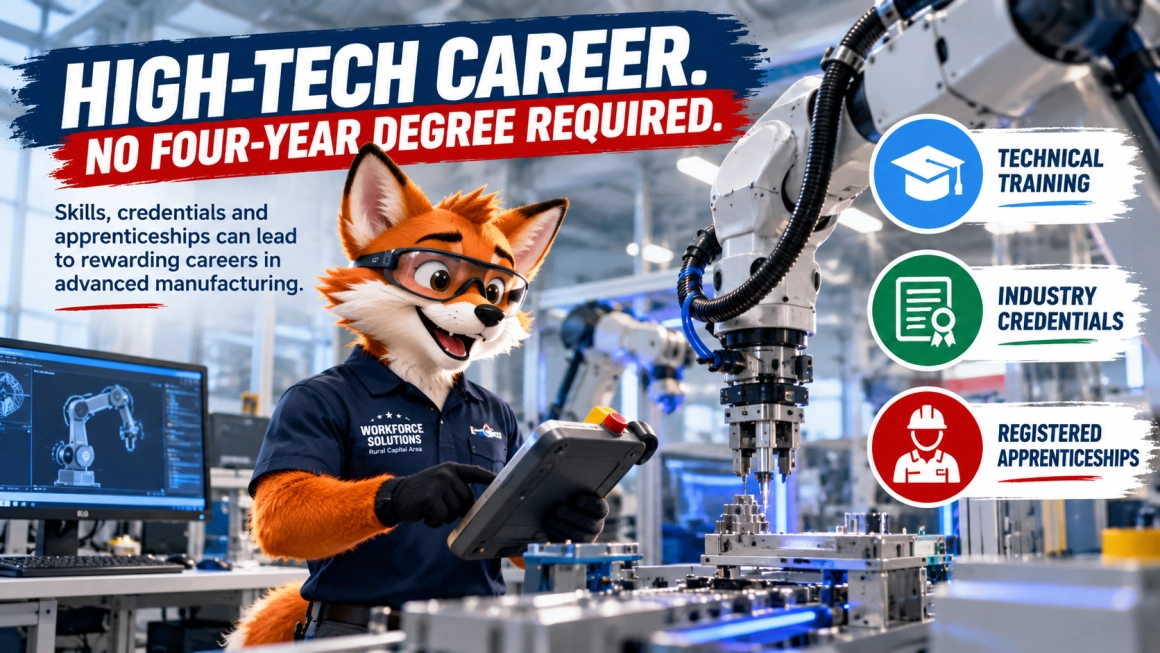
From semiconductors to robotics, some of Central Texas' most exciting career opportunities start with technical skills, hands-on training and a willingness to learn.
When you picture someone working in a high-tech career, what comes to mind?
Maybe it's a software engineer writing code, a scientist working in a laboratory or someone with an advanced degree designing the next big innovation.
But what about the person keeping a robotic production line running? The technician troubleshooting equipment that manufactures semiconductors? Or the skilled worker making sure highly automated systems operate safely and efficiently?
Those are high-tech careers, too.
And here's something worth knowing: You don't necessarily need a four-year college degree to get started.
As we celebrate Manufacturing Month across Central Texas, it's a good time to explore how technology is changing manufacturing and creating career opportunities for people with different educational backgrounds.
Manufacturing Isn't What You Might Remember
Forget the outdated picture of manufacturing as nothing but assembly lines and repetitive tasks.
Today's advanced manufacturing facilities can be filled with robotics, automated equipment, sensors, sophisticated computer systems and precision technology.
Workers don't just operate machines. They monitor performance, analyze information, troubleshoot problems and keep complex systems working together.
That takes technical knowledge, critical thinking and problem-solving skills.
And Central Texas is becoming an increasingly important place for that work.
From semiconductor production and electronic components to aerospace, automotive technology and precision manufacturing, regional employers need people who can work with increasingly advanced equipment.
According to Texas Workforce Commission projections for the Rural Capital Area, employment in semiconductor and other electronic component manufacturing is projected to grow by approximately 367.6% between 2024 and 2034.
That's a remarkable outlook for an industry that's helping shape our region's economic future.
But here's the important part: Those opportunities aren't limited to people with engineering degrees.
High-Tech Skills Don't Always Require a Four-Year Degree
There's more than one way to prepare for a technical career.
Some positions require a bachelor's degree or advanced education. Others place greater emphasis on technical training, industry credentials, hands-on experience or a combination of those qualifications.
Depending on the job, you might be able to prepare through a community college, technical school, short-term training program or registered apprenticeship.
And you don't necessarily have to choose between earning a paycheck and building your skills.
Here are a few pathways worth exploring.
1. Industry Credentials: Show What You Know
Industry-recognized credentials can help demonstrate that you've learned specific technical skills employers value.
In advanced manufacturing, those skills might include:
- Industrial maintenance and troubleshooting.
- Electrical and mechanical systems.
- Manufacturing safety and quality control.
- Automation and programmable logic controllers.
- Robotics and advanced production equipment.
Some credentials can be earned through relatively short training programs, while others require additional coursework or experience.
The important thing is choosing credentials that align with the jobs you want and the qualifications local employers are seeking.
A credential isn't necessarily the finish line. It can be your starting point.
And as technology changes, additional certifications and training can help you keep moving forward.
2. Technical Education: Learn by Doing
Not everyone learns best in a traditional classroom.
For people who enjoy working with their hands, solving problems and understanding how things work, technical education can be a strong pathway into manufacturing.
Technical colleges and community colleges offer programs that combine classroom instruction with practical experience.
Students may learn how to diagnose mechanical problems, work with electrical systems, understand automation or maintain sophisticated industrial equipment.
Some programs lead to certificates, while others lead to associate degrees.
Both can help prepare students for technical positions, depending on employer requirements.
And these opportunities aren't just for recent high school graduates.
Adults looking to change careers, workers seeking advancement and people returning to the workforce can all benefit from technical training.
3. Registered Apprenticeships: Earn While You Learn
What if you could develop high-tech skills while getting paid to work?
That's the idea behind a registered apprenticeship.
Registered apprenticeships combine paid, supervised on-the-job learning with related classroom instruction. Participants build practical skills, gain experience with real equipment and work toward a recognized occupational credential.
It's a pathway that benefits both workers and employers.
Workers earn wages while learning a trade. Employers help develop talent with the specific skills their operations need.
Here in Central Texas, WSRCA is helping advance that approach through a Maintenance Technician Registered Apprenticeship developed with Texas State Technical College (TSTC) at its East Williamson County campus in Hutto and regional workforce and industry partners.
The one-year earn-and-learn program is designed to prepare participants for industrial maintenance careers while supporting the technical workforce needs of area manufacturers.
The training includes an industry-recognized credential through the Smart Automation Certification Alliance (SACA).
It's an example of how education, employers and workforce partners can work together to create more direct pathways into high-demand careers.
And it's also a reminder that learning doesn't have to stop when someone starts working.
4. Start Somewhere. Keep Growing.
One of the most encouraging things about manufacturing careers is that your first job doesn't have to be your last.
Someone might begin in an entry-level production position, discover an interest in industrial maintenance and pursue additional training.
A maintenance technician might develop expertise in automation, robotics or advanced electrical systems.
An experienced worker might eventually move into quality assurance, supervision, operations or technical leadership.
Some of those steps may require additional credentials, education or experience. Others may come through employer-provided training and advancement opportunities.
The point is that career growth doesn't always follow one straight line.
And a four-year degree can still be part of that journey if you decide it's the right next step.
The goal isn't to choose one kind of education over another. It's to understand your options and find a pathway that fits your goals.
The Skills Employers Need Are Changing
As manufacturing becomes more advanced, employers need workers who can do more than follow instructions.
They need people who can adapt, learn new technology, solve problems and work effectively with others.
Technical knowledge matters, but so do reliability, communication, teamwork and a willingness to keep learning.
That's encouraging news for people who may not have followed a traditional educational path.
Maybe you've spent years repairing vehicles, working with electrical equipment, operating machinery or solving mechanical problems.
Maybe you're a recent graduate who enjoys technology but doesn't want to spend four years in a classroom.
Or perhaps you're looking for a career change and wondering whether the skills you've already developed could transfer into something new.
You may have more to build on than you realize.
Why This Matters for Central Texas
Manufacturing is already an important part of our nine-county Rural Capital Area economy.
Approximately 27,700 people work in manufacturing across Bastrop, Blanco, Burnet, Caldwell, Fayette, Hays, Lee, Llano and Williamson counties.
And the opportunities can be rewarding.
Regional manufacturing jobs pay average annual wages exceeding $112,000, according to workforce data. That figure represents an industrywide average across many occupations and experience levels, not an expected starting salary.
As more advanced manufacturing employers invest in our region, preparing local talent becomes increasingly important.
That means helping students understand technical career options, supporting adults who want to develop new skills and working with employers to build training opportunities that respond to real workforce needs.
It also means recognizing that talent exists in every community, not just among people who already have a particular degree.
Your Future Doesn't Have to Follow Someone Else's Path
There's nothing wrong with earning a four-year degree. For many careers, it's essential.
But it's not the only way to build a successful future.
A technical certificate can open a door. An apprenticeship can turn an interest into a profession. An entry-level job can become the beginning of a long-term career.
And the skills you learn along the way can help you adapt as industries and technologies continue to evolve.
At WSRCA, we're committed to helping Central Texans explore career pathways, connect with training opportunities and discover where their abilities can take them.
Through our partnerships with employers, educators and training providers, we're working to make those opportunities more accessible throughout our region.
The future of manufacturing is high-tech. But the path into it doesn't have to be complicated.
You don't have to know exactly where your career will end up.
You just have to find a place to start.
Ready to explore your options?
Connect with a WSRCA Career Coach to learn more about technical training, registered apprenticeships and career opportunities in Central Texas.
Because there's more than one path to a great career, and all paths lead forward.