
What Skills Should I Be Hiring for Right Now?

Posted by: Brian Hernandez
Hiring used to feel a little more straightforward.
You had an opening. You wrote a job description. You looked for someone who had done the job before. Hopefully, you found the right person.
Today? Not so simple.
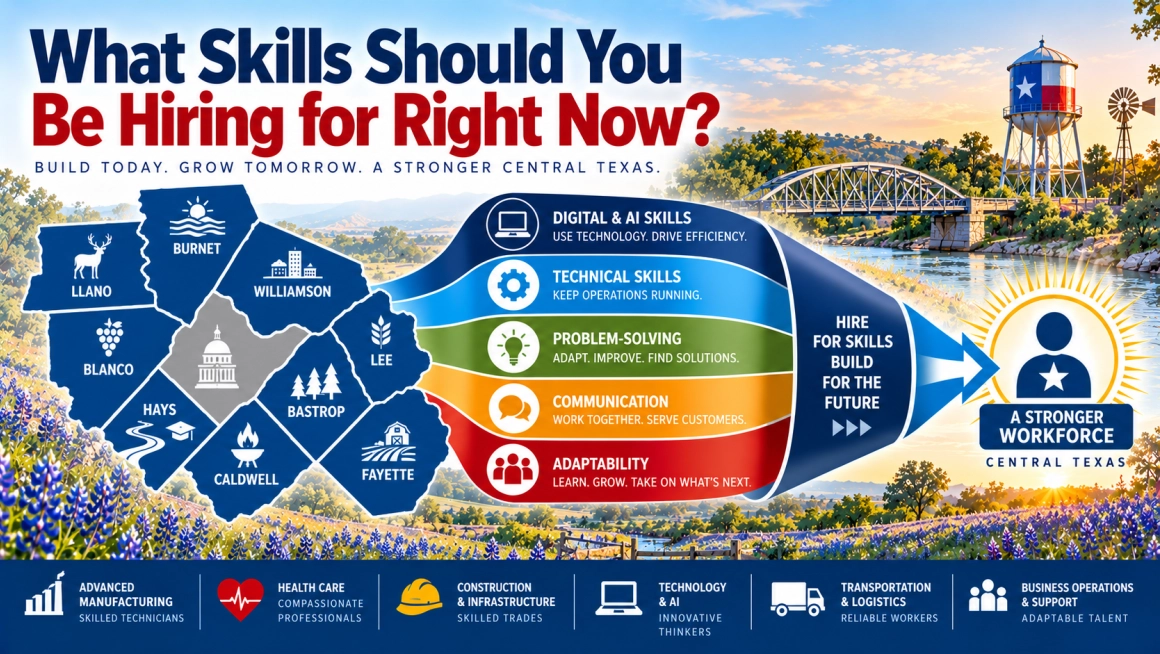
Across Central Texas, employers are growing alongside communities and industries that are changing quickly. Advanced manufacturing is expanding. Health care continues to need talent. Construction, infrastructure, transportation and skilled trades support a rapidly growing region. Technology touches nearly every workplace, and artificial intelligence is changing how some tasks get done.
That raises a pretty important question for employers:
What skills should I actually be hiring for right now?
The answer may have less to do with finding someone who already knows everything and more to do with finding people who can learn, adapt, solve problems and grow with your business.
And there may be another question worth asking:
Are you looking everywhere that talent can be found?
Start With the Skills Your Business Actually Needs
Here's a worthwhile exercise.
Pull up one of your current job descriptions and look at the requirements.
How many are truly necessary to perform the job?
Does the person really need a bachelor's degree? Do they actually need five years of experience? Is experience with one specific software platform essential? Or have some of those requirements simply been carried forward every time the position opens?
That's becoming an increasingly important question in Central Texas.
Across the nine-county Rural Capital Area, employers need workers in technology, engineering, manufacturing, health care, construction, transportation, maintenance, business operations and many other fields.
When employers all look for the same credentials, degrees and years of experience, they can end up competing for the same relatively small group of people.
Skills-based hiring offers another approach.
Instead of beginning with "What credentials does this person have?", start with "What does this person need to be able to do?"
That one change can open the door to people you may never have considered before.
Look for People Who Can Learn
Technology changes. Equipment changes. Processes change. Customer expectations change.
And artificial intelligence is accelerating some of that change.
An employee who knows today's system is valuable.
An employee who can learn tomorrow's system may be even more valuable.
That's particularly important in a Central Texas economy with significant activity in advanced manufacturing, semiconductors, health care, construction, engineering and technology.
The technical skill you desperately need today may be different three years from now.
That's why adaptability matters.
Look for curiosity. Look for people who ask good questions. Look for employees who have learned new systems before. Look for candidates who can take something unfamiliar, figure it out and apply what they've learned.
You can teach someone how to use a piece of equipment.
Teaching someone to want to keep learning can be a lot harder.
Hire Problem-Solvers, Not Just Task-Doers
AI can generate text. Software can automate processes. Machines can perform increasingly complicated tasks.
But somebody still has to recognize when something isn't working.
That's where human skills become incredibly valuable.
Can someone troubleshoot a problem? Can they make a sound decision when the answer isn't obvious? Can they recognize when an AI-generated answer doesn't make sense? Can they adapt when the plan changes?
Think about how that plays out across Central Texas.
A manufacturing technician diagnoses a piece of equipment that's gone down.
A nurse recognizes something unusual with a patient.
An HVAC technician figures out why a system isn't performing correctly.
A construction supervisor responds when conditions change on a jobsite.
An office employee catches an error in an AI-generated report before it reaches a customer.
Different occupations. Different industries.
Same underlying value.
They can think.
Communication Isn't Just a "Soft Skill"
We sometimes separate skills into "technical skills" and "soft skills."
That distinction is becoming less useful.
Communication is a business skill.
Employees need to listen, understand instructions, work with teammates, communicate with supervisors, document problems and sometimes explain complicated information to customers.
That doesn't mean everyone you hire needs to be a public speaker.
It means someone with terrific technical skills can still struggle if they can't work effectively with the people around them.
As technology handles more routine tasks and transactions, those human interactions may become even more valuable.
Yes, You Should Be Thinking About AI Skills
But that doesn't mean every Central Texas business suddenly needs to hire an AI expert.
For most employers, there's a much more practical question:
Can this person use technology to do the job better?
For an office employee, that could mean using AI to organize information, analyze a document or create a first draft.
For a manufacturer, it could mean working with increasingly automated equipment or interpreting production data.
For someone in health care, technology may assist with information, records and workflows.
For a skilled tradesperson, it might mean using digital diagnostic equipment.
The specific tool will change.
That's why digital adaptability may ultimately be more valuable than mastery of one particular application.
Employers also have a role in developing those skills.
You can't expect employees to arrive knowing how to use technology your business hasn't adopted yet.
Sometimes the answer isn't hiring someone new.
It's helping a good employee learn something new.
Don't Keep Fishing in the Same Pond
This may be one of the biggest opportunities for employers across Central Texas.
If you're struggling to find workers but continue recruiting the same candidates, with the same requirements, through the same channels, something probably needs to change.
There is talent in our communities that can be overlooked because it doesn't arrive in the package employers traditionally expect.
That includes veterans and transitioning service members, people with disabilities, young adults entering the workforce, older workers, career changers and Second Chance job seekers returning to the workforce after involvement with the justice system.
These aren't charity hires.
They're potential employees.
And looking at skills instead of labels can completely change the conversation.
Second Chance Can Mean a Second Look at Talent
For someone returning to the workforce after incarceration or another justice-system barrier, getting a job can be an important part of rebuilding stability.
But a criminal record can continue to close doors even when someone has completed training, earned credentials, gained work experience and is ready to work.
Employers shouldn't ignore legitimate safety, licensing or legal requirements. But a record doesn't necessarily tell you whether someone has the skills or potential to succeed in a particular job.
Texas even has infrastructure specifically designed to connect employers with this talent pool. The Texas Department of Criminal Justice operates Website for Work, which connects qualified people returning from incarceration with employers based on education, vocational training, certifications, work experience and an employer's workforce needs.
The Texas Workforce Commission also offers Fidelity Bonding for eligible workers who may have difficulty obtaining employment. The free bond generally provides $5,000 in coverage for the first six months, with no deductible, and justice-involved individuals are among the populations that may qualify.
That's why Second Chance hiring shouldn't simply be viewed through the lens of someone's past.
Ask what they can contribute to your future.
Veterans May Have the Skills Without the Job Title
The same principle applies to veterans.
A résumé may not say "operations manager," "logistics specialist" or "maintenance technician" in exactly the terminology your company uses.
That doesn't mean the skills aren't there.
Military experience can include leadership, technical training, logistics, problem-solving, teamwork, accountability and the ability to perform under pressure.
Texas Workforce Commission resources specifically help employers connect with veterans and translate military experience into civilian occupations.
Instead of asking whether a veteran has held your exact civilian job title, ask whether their experience translates into the work you need done.
Disability Doesn't Define Ability
People with disabilities are another talent pool employers can unintentionally overlook.
Sometimes the barrier isn't whether someone can perform the essential functions of a job. It's whether the recruiting, interviewing or workplace process gave that person a fair opportunity to demonstrate what they can do.
Texas Workforce Solutions-Vocational Rehabilitation Services works with people with disabilities to prepare for, obtain and maintain employment. Work-based programs also give employers opportunities to meet and develop talent.
For example, Texas' Summer Earn and Learn program provides students with disabilities paid workplace experience with local employers, while wages, workers' compensation and reasonable accommodations are provided through the program.
For an employer thinking about tomorrow's workforce, that's more than a summer job.
It's an opportunity to start building a talent pipeline.
Give Young People a First Chance
There's another group with an obvious problem when employers require experience:
Young people.
You can't have three years of experience if nobody gives you your first year.
That's why internships, work-based learning, job shadowing, apprenticeships and other early career experiences matter so much.
Central Texas employers don't have to wait until young people finish their education to begin connecting with them.
Let them see the workplace.
Let them meet your employees.
Let them understand what your industry actually does.
Give them an opportunity to learn.
The 17-year-old who knows nothing about your company today could become the technician, nurse, welder, engineer, supervisor or business owner your community needs tomorrow.
Don't Forget Career Changers and Older Workers
Experience doesn't always come from the same industry.
Someone who's spent 15 years in hospitality may understand customer service, scheduling, problem-solving and working under pressure.
Someone coming from retail may understand sales, inventory, teamwork and customer behavior.
An older worker may bring decades of workplace experience, reliability and institutional knowledge.
A parent returning to work may have a résumé gap but still have valuable skills.
A candidate changing careers may not check every technical box on day one but could bring something equally valuable: transferable skills.
The question isn't always:
"Have you done this exact job before?"
Sometimes it's:
"What can you already do, and what could we help you learn?"
Stop Looking for the Unicorn
We've all seen the job posting.
Five years of experience. A degree. Three certifications. Knowledge of six software systems. Leadership experience. Excellent communication skills.
Entry level.
At some point, you have to ask whether that person actually exists.
Maybe your strongest candidate checks seven of your ten boxes.
Could you teach the other three?
That's where hiring and workforce development start becoming the same conversation.
On-the-Job Training can help people develop skills while they're working. Registered Apprenticeship can help businesses create structured pipelines around the occupations they need. Work-based learning can introduce people to an industry while giving them experience.
And training doesn't have to stop once someone is hired.
Helping an existing employee gain new skills can sometimes be faster, less expensive and more effective than starting another external search.
Your Best Candidate May Already Work for You
Before posting another job, look around.
Who already understands your customers?
Who knows your operation?
Who shows up?
Who solves problems?
Who takes initiative?
Who has earned the trust of the people around them?
Sometimes an employer thinks it has a recruiting problem when it actually has an advancement opportunity.
Training an existing employee for the next position can create two opportunities at once.
Someone moves up.
Then an entry-level position opens for someone new.
That's how a talent pipeline begins to form.
Not one vacancy at a time, but as a pathway.
Hire for Tomorrow, Not Just Tuesday
You may need a maintenance technician today.
But what will that technician need to know three years from now?
You may need a production worker today.
Could that person eventually become a technician, supervisor or manager?
You may hire someone for an administrative position.
Could that employee learn new digital tools and eventually perform work that doesn't even exist today?
That's the bigger question:
Are you hiring someone to fill today's vacancy, or are you building the workforce your business will need tomorrow?
Those are two very different strategies.
WSRCA Can Help You Look at Talent Differently
Workforce Solutions Rural Capital Area (WSRCA) works with employers across Bastrop, Blanco, Burnet, Caldwell, Fayette, Hays, Lee, Llano and Williamson counties to connect businesses with people, training and workforce solutions.
Sometimes that means helping recruit for an immediate opening.
But the bigger conversation can include identifying the skills your business needs, exploring training options, building career pathways, connecting with untapped talent and creating longer-term pipelines.
It can also mean connecting employers with partners and programs serving veterans, people with disabilities, young adults, Second Chance job seekers and others who may have traditionally been overlooked.
Because when the labor market gets tight, the answer isn't always to keep looking harder for the same candidate.
Sometimes it's to look differently.
The future of hiring may be less about asking:
"Does this person already know everything I need?"
And more about asking:
"Does this person have the skills, potential and opportunity to learn what we'll need next?"
The jobs are changing.
The skills are changing.
And some of the best talent in Central Texas may already be here.
We just have to make sure we're not overlooking it.