
How Far Can a Healthcare Career Take You in Central Texas?

Posted by: Brian Hernandez
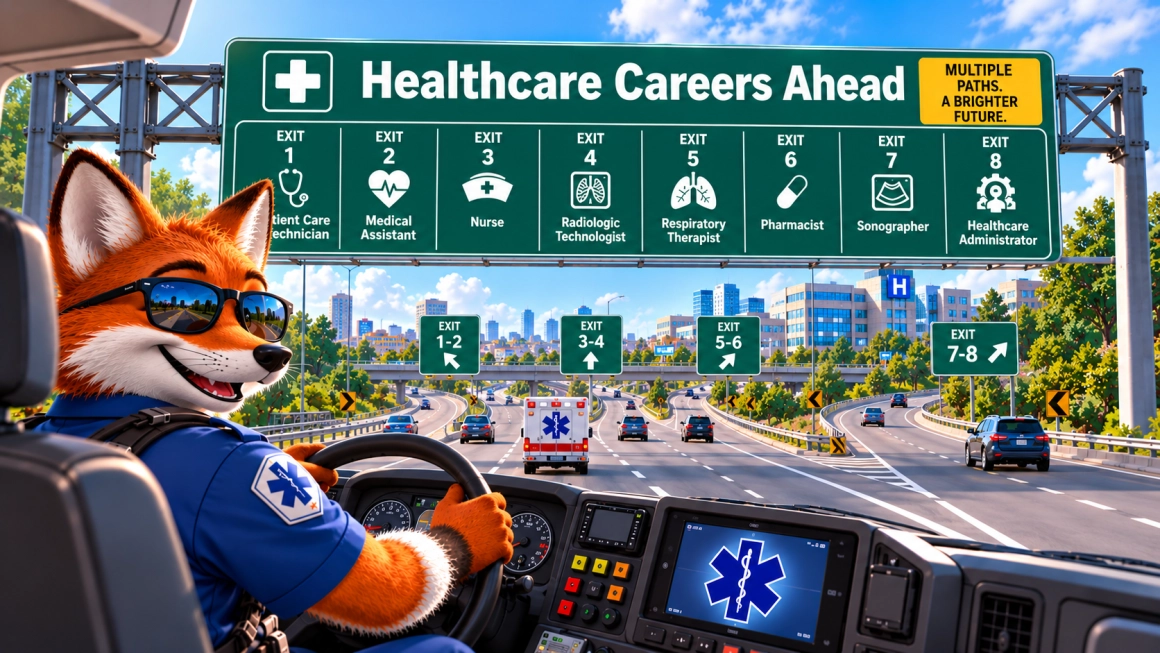
You don't have to become a doctor to build a great career in health care.
And you don't necessarily need to spend four years in college before you can get started.
That's one of the most interesting takeaways from the new Central Texas Healthcare Workforce Needs and Education Pipeline Study, led by Workforce Solutions Rural Capital Area (WSRCA) in partnership with Workforce Solutions Capital Area and Opportunity Austin.
The study takes a deep look at healthcare jobs, earnings, education and training across Bastrop, Blanco, Burnet, Caldwell, Fayette, Hays, Lee, Llano, Travis and Williamson counties.
And the numbers tell an interesting story.
Healthcare isn't one career path. It's a whole collection of them.
Some high-demand careers can begin with a certificate. Others typically require an associate degree. Some require a bachelor's, master's or advanced professional education.
And as education, skills, credentials and responsibility increase, earnings can increase dramatically.
So, how far can a healthcare career take you in Central Texas?
Potentially a very long way.
Healthcare Isn't One Career
Say "healthcare career," and a lot of us immediately picture a doctor or nurse.
But walk through a hospital, clinic, rehabilitation facility, physician's office or other healthcare setting and you'll find a much bigger workforce.
Medical assistants. Nursing assistants. Pharmacy technicians. Licensed vocational nurses. Registered nurses. Lab technicians. Physical therapist assistants. Occupational therapists. Speech-language pathologists. Nurse practitioners.
Those jobs don't require the same education. They don't perform the same work. And they certainly don't earn the same amount.
That's actually what makes health care such an interesting field for someone trying to figure out a career.
There isn't just one way in.
You May Not Need a Four-Year Degree to Get Started
Here's a number that might surprise you.
Of the 15 highest-demand healthcare occupations identified in the Central Texas study - 11 typically require less than a bachelor's degree for entry.
That doesn't mean no education or training is required.
Quite the opposite.
Health care is built around skills, credentials, licensing and patient safety. Depending on the occupation, that could mean completing a certificate program, earning an associate degree, passing an examination, obtaining a professional license or continuing into graduate education.
But you may not have to complete your entire educational journey before you begin building your career.
That's where things get interesting.
What Can Another Credential Be Worth?
Take a look at the earning potential among some of the region's high-demand healthcare careers.
A medical assistant has median annual earnings of about $45,300.
A licensed practical or licensed vocational nurse is around $63,600.
A physical therapist assistant is around $80,200.
Registered nurses are near $94,000.
At the advanced-degree level, several of the high-demand careers studied cross six figures. Physical therapists have median annual earnings of about $100,500, speech-language pathologists about $101,300, occupational therapists about $105,800, and nurse practitioners nearly $134,700.
That's a pretty remarkable range.
But there's an important point here.
Earning another credential doesn't automatically turn one job into another. Each occupation has its own education, licensing, admission and professional requirements.
The lesson isn't that everyone should chase the highest number.
It's that education and training decisions can have a very real impact on where a healthcare career can take you.
Before choosing a program, don't just ask what first job it prepares you for.
Ask what might come next.
You Don't Have to Start at the Finish Line
This may be the most useful lesson for someone exploring health care.
You don't necessarily have to know today what you want to be doing 15 years from now.
Maybe your first goal is simply getting into the industry.
A certificate can provide an entry point into some occupations. An associate degree can open others. Once you're working, you're also learning about the industry, meeting people doing different jobs and discovering which parts of health care interest you.
Then you can decide whether continuing your education makes sense.
Consider nursing.
Central Texas had about 20,000 registered nursing jobs in 2025, and the study projects approximately 1,455 average annual openings from 2026 through 2031. Median annual earnings are nearly $94,000.
And there isn't just one educational route into registered nursing. The study identifies either an Associate Degree in Nursing or a Bachelor of Science in Nursing as typical entry-level credentials.
That doesn't mean every nursing career follows the same path.
It means there are choices.
Understanding those choices before investing your time and money can make a big difference.
Two Years of Education Can Go a Long Way
One occupation in the study really jumps out: physical therapist assistant.
The typical entry-level credential is an associate degree.
Median annual earnings in the region are about $80,200.
Central Texas had nearly 1,850 physical therapist assistant jobs in 2025, and the occupation is projected to have approximately 439 average annual openings through 2031.
That's a good reminder that "healthcare career" doesn't automatically mean medical school or even a bachelor's degree.
It's also why it's worth looking beyond the job title when you're exploring a career.
Ask:
What does it pay? How much education does it require? Is there demand? And where can it take me next?
A career decision can look very different when you consider all four.
The Most Openings Don't Always Mean the Highest Pay
Here's another lesson hiding in the numbers.
Home health and personal care aides have the largest projected number of annual openings among the 15 high-demand occupations studied, at about 3,455 per year.
Median annual earnings are approximately $27,500.
Compare that with nurse practitioners.
Their median annual earnings are nearly $134,700, but the region is projected to have about 282 average annual openings.
Neither number tells you which career is "better."
Instead, they teach us something important:
Demand and pay aren't the same thing.
A job can have lots of openings because an industry is growing. Openings can also be created when people retire, leave the workforce or move into other occupations.
That's why choosing a career based solely on a list of "hot jobs" can be misleading.
You need to understand the whole picture.
Health Care Has Plenty of Room to Grow
And there is a lot of growth to consider.
Central Texas added nearly 24,900 healthcare jobs between 2019 and 2025, and another 14,178 new healthcare jobs are projected between 2026 and 2031.
The study also projects nearly 13,900 healthcare job openings each year through 2031 when new jobs and openings created as workers leave occupations are considered.
The 15 high-demand occupations identified in the study are expected to account for 72% of the region's healthcare job growth through 2031.
And those opportunities aren't limited to hospitals.
Healthcare workers are needed in physician offices, home health services, nursing facilities and other ambulatory healthcare settings, too.
That's particularly important in a region as geographically diverse as Central Texas.
People need care wherever people live.
Where You Live Can Affect Your Path
There's another challenge the study uncovered that deserves attention.
Healthcare training isn't equally available across Central Texas.
The study identified no postsecondary healthcare training providers in Blanco, Caldwell, Lee or Llano counties, highlighting the need to bring more education and training opportunities closer to where people live and work.
That's a workforce issue.
A training program may look affordable on paper, but transportation, distance, work schedules, child care and the time required to travel can become very real barriers.
That's why expanding local training, clinical placements, apprenticeships and other earn-and-learn opportunities matters.
If Central Texas needs more healthcare workers, we also need to make it possible for more Central Texans to become them.
Your Healthcare Career Can Start Before Graduation
The pipeline starts even earlier.
Across the region's 67 independent school districts, thousands of students are already participating in healthcare-related Career and Technical Education programs, including nursing science, biomedical science, health informatics, and diagnostic and therapeutic services.
That gives students an opportunity to explore health care before making a major education or financial commitment.
And career exploration matters.
It's one thing to think a career sounds interesting.
It's another to see the work, meet someone doing it and understand what the job is actually like.
A student who discovers an interest in health care today could eventually become tomorrow's medical assistant, nurse, therapist, technician or healthcare leader.
Don't Just Ask, "What Can I Become?"
Ask:
Where can I begin?
Maybe you aren't ready for four years of college.
Maybe you're already working and can't stop earning a paycheck for several years.
Maybe you're changing careers at 35, 45 or 55.
Maybe you're a high school student who has absolutely no idea whether you'll enjoy working in health care.
That's okay.
Start by exploring.
What does the person actually do all day? What education and training are required? How much will that training cost? How long will it take? What does the job typically pay? Are employers hiring? Does the occupation require a license or certification? Can the education you earn today help you move toward something else tomorrow?
And perhaps most importantly:
Can you see yourself doing the work?
A six-figure salary doesn't make a career right for you.
Neither does a short training program.
The best pathway connects your interests and abilities with a real opportunity to build the life you want.
A Job Can Be a Destination or a Beginning
The Central Texas Healthcare Workforce Needs and Education Pipeline Study wasn't designed simply to count jobs.
It gives employers, educators, workforce partners and communities a roadmap for strengthening the region's healthcare workforce.
Among the opportunities identified are expanding training in high-demand fields, increasing clinical placements, strengthening pathways from entry-level healthcare positions into nursing careers, and expanding apprenticeships and other earn-and-learn models.
That's important for employers trying to build a talent pipeline.
But it's equally important for the person trying to build a career.
A healthcare job can be a destination. It can also be the beginning of something bigger.
Start With the Destination, Then Build Your Path
At WSRCA, we talk a lot about career pathways because careers don't always happen in one giant leap.
Sometimes they're built one skill, one credential and one opportunity at a time.
For someone exploring health care, that could mean career exploration first. It could mean training for an entry-level occupation, gaining experience and then deciding to continue your education. Or it could mean pursuing an advanced career from the beginning.
There's no single correct route.
But there is a smarter way to make the decision.
Look at where you want to go. Understand what it takes to get there. Then build the pathway that makes sense for you.
Because in Central Texas, a healthcare career can start in a lot of different places.
How far it takes you may depend on what you decide to learn next.