
Workplace Accommodations Don't Have to Be Complicated

Posted by: Brian Hernandez
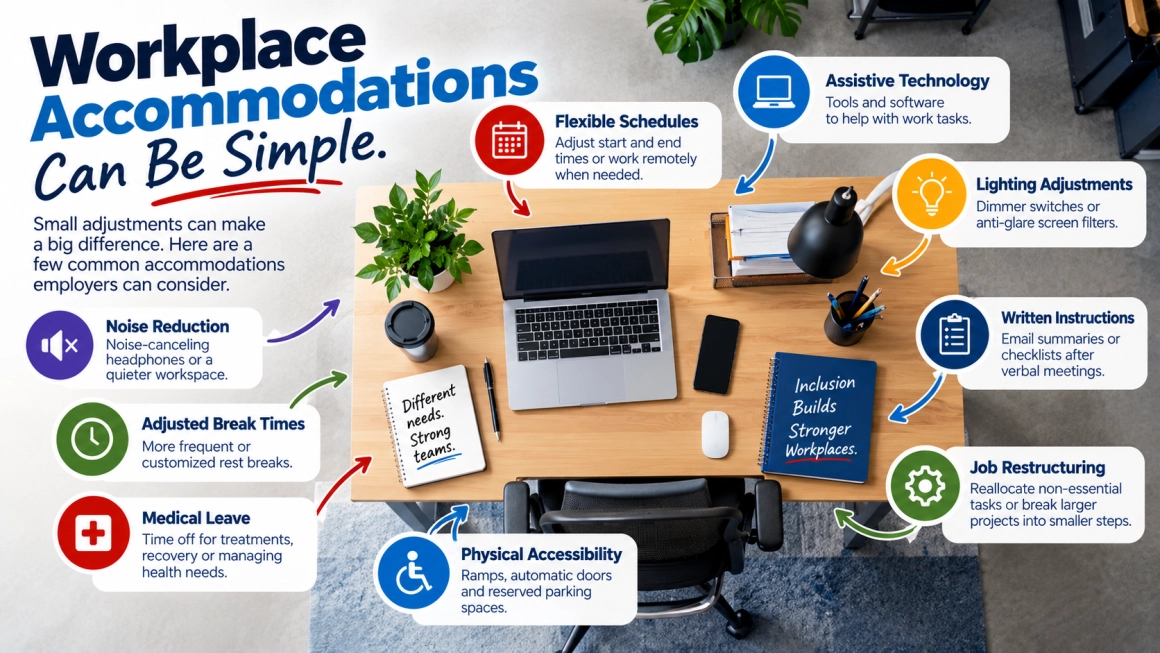
What if the next great addition to your team is someone whose talent you've overlooked? Or what if keeping one of your best employees only requires a small adjustment to how they work?
During National Disability Employment Awareness Month (NDEAM), we're celebrating the skills, talents and contributions of people with disabilities. We're also encouraging Central Texas employers to think about something that benefits every workplace: inclusion.
Because building an inclusive workplace isn't about lowering expectations or making exceptions. It's about recognizing people's abilities, removing unnecessary barriers and giving everyone a fair opportunity to succeed.
And workplace accommodations are often much simpler than employers might think.
Inclusion Isn't Just the Right Thing to Do. It's Good for Business.
Every employer wants a team that's dependable, motivated and capable of getting the job done.
But great employees don't all look, think, communicate or work the same way. That's a strength, not a weakness.
People with disabilities bring valuable skills, experiences and perspectives to the workplace. Some have spent years developing creative ways to solve problems, adapt to challenges and navigate environments that weren't designed with their needs in mind.
Those experiences can translate into valuable workplace strengths.
When employers build workplaces where more people can contribute, they're also expanding their access to talent, supporting employee retention and creating teams where different perspectives are valued.
Inclusion also sends an important message to every employee: You belong here, your contributions matter and we want you to succeed.
That's the kind of workplace people want to be part of.
Let's Bust a Few Myths About Workplace Accommodations
The words "reasonable accommodation" can sound intimidating. Employers might picture expensive equipment, major renovations or complicated legal requirements.
But that's rarely the whole story.
Myth #1: Accommodations are expensive.
Many accommodations cost absolutely nothing.
Research from the U.S. Department of Labor's Job Accommodation Network (JAN) has consistently found that a substantial share of workplace accommodations come at no cost to employers.
Others involve modest, one-time expenses.
A flexible schedule, written instructions, adjusted lighting or a quieter workspace might be all someone needs to perform at their best.
Sometimes, the solution is already available.
Myth #2: Accommodations mean lowering job expectations.
Not at all.
An accommodation doesn't mean an employee gets a free pass on essential job responsibilities. It means removing a barrier that might prevent a qualified person from performing those responsibilities effectively.
Think about an employee who has difficulty hearing verbal instructions in a busy manufacturing environment. Providing written directions or visual alerts doesn't change the work that needs to get done.
It simply makes the information more accessible.
The standard stays the same. The path to meeting it becomes more accessible.
Myth #3: Every accommodation requires special equipment.
Some accommodations involve assistive technology or modified equipment, but many are changes to everyday workplace practices.
They might include:
- Flexible schedules or adjusted break times.
- Written instructions or alternative communication methods.
- Accessible software and digital tools.
- Changes to lighting, seating or workstation arrangements.
- Noise reduction or quieter work areas.
- Modified equipment or accessible workspaces.
There's no one-size-fits-all solution. What works for one employee might not work for another.
And that's exactly why listening matters.
Myth #4: Accommodations are complicated to manage.
Often, the best place to start is a conversation.
What part of the job is creating a challenge? What adjustment could help? Is there a practical solution that works for both the employee and the business?
Under the Americans with Disabilities Act (ADA), covered employers generally must provide reasonable accommodations to qualified individuals with disabilities unless doing so would create an undue hardship.
Employers don't necessarily have to provide the exact accommodation requested if another effective solution is available.
The goal is to work together to identify what will help the employee succeed while meeting the needs of the business.
And employers don't have to navigate that process alone.
What Inclusion Looks Like in Central Texas
Imagine a skilled manufacturing employee who needs an adjusted workstation to continue doing excellent work.
Or a customer service representative who uses assistive technology to communicate effectively.
Maybe it's a healthcare employee who benefits from a modified schedule, or an office professional who does their best work with fewer distractions.
These are examples of how thoughtful workplace adjustments can help people contribute their skills and experience.
And the benefits don't always stop with one employee.
Clearer instructions can improve communication across an entire team. More accessible technology can make everyday tasks easier. Flexible workplace practices can help businesses respond to different employee needs.
When employers identify and remove barriers, they often discover opportunities to improve the workplace for everyone.
The Best Candidate Might Not Check Every Box
Hiring has never been just about finding someone who looks perfect on paper.
It's about recognizing potential.
A person with a disability might bring the technical skills, experience, dedication or problem-solving ability an employer needs. But if the hiring process or workplace isn't accessible, that talent might never get the opportunity to shine.
That's why inclusion starts before someone is hired.
It means considering whether job postings are accessible, interviews allow candidates to demonstrate their qualifications and hiring decisions focus on the essential skills needed for the job.
It also means recognizing that disabilities aren't always visible.
An employee shouldn't have to fit a narrow idea of what a successful worker looks like to be valued.
The question employers should be asking isn't whether someone works exactly like everyone else.
It's whether that person has the ability and support to do the job successfully.
We're Here to Help Employers See What's Possible
At Workforce Solutions Rural Capital Area (WSRCA), we believe opportunity grows when employers recognize the value of every person's abilities.
That's why we're proud to partner with Vocational Rehabilitation (VR) Services to help individuals with disabilities prepare for, find, maintain and advance in meaningful employment.
Together, we're working to connect employers with talented candidates, strengthen workforce participation and help businesses better understand the resources available to support employees with disabilities.
VR Services can assist eligible individuals with employment preparation, training, job placement and workplace-related support. Employers can also access information and resources that support inclusive hiring and employment practices.
The Job Accommodation Network is another valuable resource, offering free, confidential guidance on reasonable accommodations and practical workplace solutions.
Whether you're a small business hiring your first employee with a disability or a larger employer looking to strengthen your workplace practices, you don't have to figure everything out on your own.
You just have to be willing to explore what's possible.
Inclusion Is About Opportunity, Not Limitations
National Disability Employment Awareness Month reminds us that people with disabilities are already making important contributions to businesses and communities across Central Texas.
But recognizing those contributions shouldn't end when October does.
Inclusion is something we build every day through the people we hire, the opportunities we create and the barriers we're willing to remove.
It's about seeing someone's potential before making assumptions about their limitations.
It's about recognizing that talent comes in many forms.
And it's about understanding that a small workplace adjustment can make a meaningful difference in someone's career, their independence and their future.
When we make workplaces more accessible, we don't just open doors for people with disabilities. We create more opportunities for our businesses, our communities and our entire workforce to succeed.
That's a future worth building together.
Let's Get to Work.
Connect with Workforce Solutions Rural Capital Area to learn how our no-cost employer services and partnership with VR Services can help you discover talent, support your employees and build a stronger, more inclusive workforce.