
Building Hutto's Workforce Future Together

Posted by: Brian Hernandez
Few communities in Texas have a growth story quite like Hutto's.
Drive through the city today and in addition to quite a few Hippo's 🦛, you'll see new neighborhoods, new businesses, new schools, and new infrastructure taking shape in every direction. The numbers tell the same story. Hutto's population has grown to nearly 49,000 residents, local employment has reached more than 12,400 jobs, and average annual earnings now exceed $82,000. It's the kind of momentum many communities hope for.
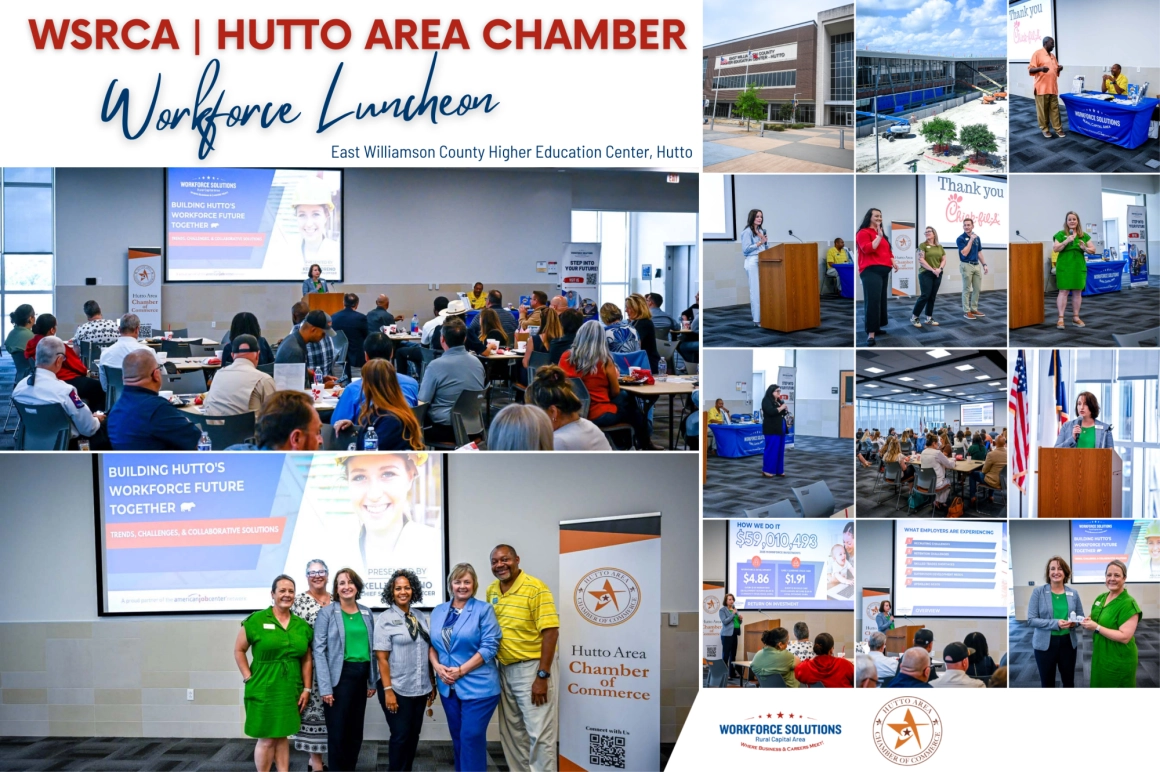
That growth was the focus of discussion this week as Workforce Solutions Rural Capital Area (WSRCA) joined local employers, community leaders, and business partners at the Hutto Area Chamber of Commerce's monthly luncheon held at the East Williamson County Higher Education Center.
WSRCA Chief Solutions Officer Kelly Moreno shared insights on Hutto's economy, workforce trends, employer challenges, and the opportunities ahead as one of the fastest-growing communities in Central Texas continues its transformation from a primarily residential community into an increasingly balanced employment center.
We're grateful to the Hutto Area Chamber for creating opportunities like these. The Chamber's monthly luncheon brings together local business leaders to discuss issues that matter to the community and helps foster the conversations needed to support continued economic growth.
Growth Creates Opportunity and Responsibility
Since 2020, Hutto has added approximately 11,500 residents, representing population growth of more than 30 percent. During that same period, employment grew by nearly 25 percent. Those are remarkable numbers that reflect the community's growing appeal to families, businesses, and developers.
Growth, however, creates new responsibilities.
As communities expand, demand increases for healthcare services, educators, skilled trades professionals, transportation infrastructure, retail businesses, restaurants, public safety personnel, and countless other occupations that support daily life. Workforce development becomes increasingly important because economic growth can only continue when employers have access to the talent they need.
The encouraging news is that Hutto already possesses one of its greatest workforce assets: people.
A Growing Workforce Looking for Opportunity
One of the most important workforce trends in Hutto is the relationship between the city's labor force and its local job base.
Today, Hutto supports roughly 21,500 workers in its labor force but has approximately 12,480 jobs located within the city. That means thousands of residents leave Hutto each day to work elsewhere across the region.
The challenge and opportunity are closely connected. Hutto already has the talent. The next chapter of the city's growth story is creating even more local employment opportunities that allow residents to live, work, and prosper in the community they call home.
For employers, that's an opportunity to access a growing pool of talent close to home. For economic developers, it's an opportunity to attract new businesses that can leverage an expanding workforce. For residents, it's an opportunity to potentially spend less time commuting and more time working closer to where they live.
As Kelly shared during her remarks, "The opportunity ahead is continuing to connect people to careers, employers to talent, and growth to long-term economic success."
That opportunity becomes even more important as Hutto continues to grow and attract new investment. The community has already built a strong workforce foundation. The focus now is ensuring that job creation, workforce development, and economic growth continue advancing together.
What Employers Are Telling Us
While every business is unique, employers across industries continue to share many of the same workforce concerns.
They're looking for qualified applicants. They're focused on retaining employees in a competitive labor market. They're searching for future supervisors and leaders. They're trying to help employees develop new skills as technology continues to change the workplace.
Those challenges aren't limited to one industry.
Healthcare providers need workers to support a growing population. Skilled trades employers need talent to support continued residential and infrastructure expansion. Retail and service-sector employers need workers as new residents continue arriving in the community.
The good news is that solutions exist when employers, educators, workforce organizations, and community leaders work together.
As Kelly noted during the presentation, "Businesses aren't simply consumers of talent. They help build talent."
That perspective is becoming increasingly important in today's labor market. Employers who engage with schools, support work-based learning opportunities, host interns, mentor students, and participate in workforce initiatives aren't simply filling positions. They're helping shape the future workforce their businesses will depend on.
Building Talent Pipelines Before They're Needed
One of the most important messages shared during the luncheon was that workforce development doesn't begin when someone applies for a job.
"The workforce pipeline doesn't begin when someone submits a job application. It begins much earlier," Kelly explained.
Students can't pursue careers they've never been exposed to. Workers can't prepare for opportunities they don't know exist. Employers can't build future talent pipelines without engaging in the process.
That's why WSRCA works across the entire workforce continuum, supporting career exploration activities, classroom engagement, internships, job shadowing opportunities, registered apprenticeships, mentoring programs, incumbent worker training, leadership development, reskilling efforts, and workforce advancement strategies.
The strongest workforce systems are built intentionally. They connect education to employment and help residents understand how today's learning opportunities become tomorrow's careers.
Just as importantly, they create opportunities for individuals at every stage of their career journey. Workforce development isn't only about preparing students for the future. It's also about helping today's workers gain new skills, advance into leadership roles, and remain competitive in a rapidly changing economy.
Strong Partnerships Create Stronger Communities
One of the advantages Hutto enjoys is the strength of its partnerships.
The East Williamson County Higher Education Center itself serves as a reminder of what collaboration can accomplish. Educational institutions, workforce partners, employers, and community leaders all play a role in helping residents develop skills and connect with opportunities.
WSRCA continues to strengthen partnerships with Austin Community College, Texas State University, Texas State Technical College, Temple College, employers, chambers of commerce, economic development organizations, and school districts throughout the region.
Those relationships matter because workforce development is ultimately a team effort.
No single organization can solve workforce challenges alone. Lasting solutions emerge when businesses communicate their needs, educators align training opportunities, workforce organizations connect resources, and community leaders create environments where opportunity can thrive.
The strongest workforce systems are built through collaboration, shared goals, and a commitment to investing in people.
Looking Ahead
Hutto's future is incredibly bright.
The city continues to attract new residents, new investment, and new business activity. Population growth remains strong. The workforce continues expanding. New opportunities continue emerging across multiple industries.
The question isn't whether Hutto will continue growing.
The question is how effectively the community can convert that growth into long-term economic prosperity.
That was the central theme of this week's conversation and a challenge that community leaders, educators, employers, and workforce partners are already working to address.
WSRCA extends its sincere thanks to the Hutto Area Chamber of Commerce for the invitation, the hospitality, and its ongoing commitment to supporting local businesses. Bringing employers together to discuss workforce challenges and opportunities helps strengthen the entire community.
When business leaders, educators, workforce partners, and local officials work together around a shared vision, communities don't just grow. They create pathways to opportunity that benefit employers, workers, families, and future generations alike.
For a city known for its hippo mascot and larger-than-life personality, the next chapter of growth will be defined not only by new residents and new businesses, but by continued investment in the people who make Hutto special.
Hutto's workforce future is being built today through the partnerships, planning, and collaboration that will create opportunity for years to come.