
Regional Partnership Takes Center Stage at ARMA Workforce Luncheon

Posted by: Brian Hernandez
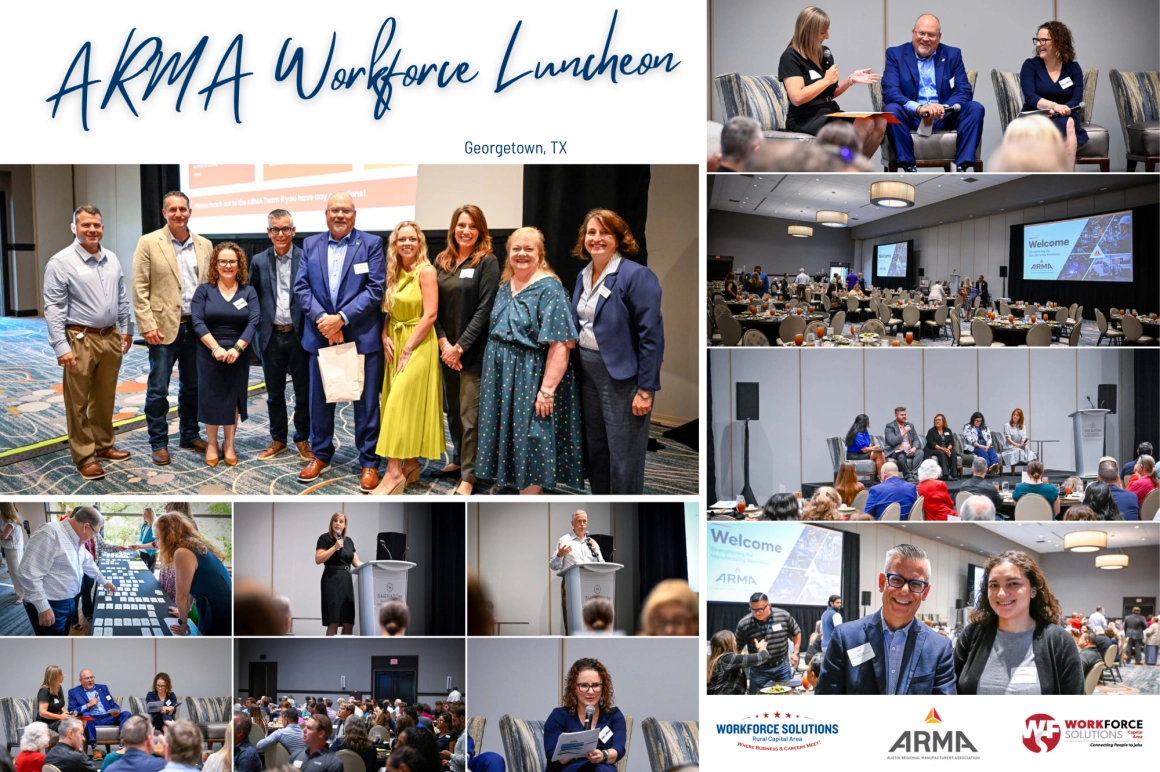
Manufacturing is changing quickly across Central Texas. New technologies, automation, and advanced production methods are reshaping the industry, but one thing hasn't changed: manufacturers need skilled people to keep growing and competing.
That shared challenge brought manufacturers, educators, training providers, and workforce leaders together today for a workforce luncheon, hosted by our partners at the Austin Regional Manufacturers Association (ARMA). Through two panel discussions, the event explored both sides of the talent equation: how the workforce system can help manufacturers address immediate and long-term needs, and how education and training partners are preparing people for the careers shaping the industry's future.
Workforce Solutions Rural Capital Area (WSRCA) CEO Paul Fletcher joined Workforce Solutions Capital Area CEO Yael Lawson for a workforce leadership discussion led by ARMA Executive Director Molly Young-Merritt. A second panel, hosted by ARMA Director of Workforce Programs Alexis Flores, brought together education and training leaders to discuss how Central Texas is developing the skilled talent manufacturers need.
Workforce Leaders Look at the Regional Talent Picture
Fletcher and Lawson joined Young-Merritt for a conversation focused on the workforce challenges manufacturers are facing and how the region's workforce system can help businesses respond.
For employers, workforce development isn't a one-size-fits-all process. One manufacturer may need help finding workers with a specific technical skill. Another may need to train experienced employees on new equipment or processes. Others may be looking several years ahead and asking how they can build a more reliable pipeline of future workers.
That's where regional collaboration becomes especially important.
WSRCA and Workforce Solutions Capital Area serve different parts of Central Texas, but employers and workers don't experience the economy according to workforce-area boundaries. People may live in one community, train in another, and work somewhere else entirely. Manufacturers may recruit across the region while working with suppliers, customers, and partners in multiple counties.
By working together, the two workforce boards can connect employers with a broader range of labor market insights, workforce programs, training resources, funding opportunities, and talent solutions.
The goal isn't simply to fill today's openings. It's to help manufacturers build the workforce they'll need tomorrow.
Manufacturing Talent Doesn't Stop at a County Line
Central Texas is one connected economy, which makes partnership particularly important for an industry as interconnected as manufacturing.
A company looking for a technician, production specialist, engineer, or other skilled worker isn't concerned with where one workforce area ends and another begins. It needs the right person with the right skills.
That same regional approach applies to workforce development. Employers, school districts, colleges, training providers, economic development organizations, and workforce boards all bring different resources and expertise to the table.
When those partners coordinate their efforts, manufacturers gain access to a larger talent ecosystem. Workers and students also gain clearer pathways to opportunities throughout Central Texas.
Educators Explore How to Build the Next Generation of Talent
The luncheon's second panel shifted the conversation from the broader workforce system to the education and training pipeline that prepares people for manufacturing careers.
Hosted by Flores, the discussion featured Dr. Laura Marmolejo, Dean of Advanced Manufacturing at Austin Community College; Nathan Mouser, Coordinator of Bastrop ISD's P-TECH Program; Kelly Coke, Ed.D., Provost at Texas State Technical College; and Alyssa Reinhart, Director of Workforce Development at the Texas Institute for Electronics.
Their perspectives reflected the many points where someone can enter or advance within the manufacturing talent pipeline, from career exploration in high school to technical education, specialized training, credentials, and continued skill development throughout a career.
That's increasingly important because today's manufacturing careers look very different from outdated perceptions of the industry.
Automation, robotics, electronics, semiconductors, advanced equipment, and increasingly sophisticated production processes are creating careers that combine technical knowledge with problem-solving, adaptability, and hands-on skills. Preparing people for those opportunities requires education and industry to remain closely connected.
Building the Talent Pipeline Starts Before the Job Posting
Manufacturers can't wait until a position is open to begin thinking about their future workforce.
Programs such as P-TECH can introduce students to technical careers while they're still in high school, helping them connect classroom learning with real career opportunities. Community colleges, technical colleges, and specialized training organizations can build on those foundations by providing the technical skills and credentials employers need.
Employers have an important role in that process, too.
By engaging with schools, colleges, workforce organizations, and training providers, manufacturers can help students understand what modern manufacturing actually looks like. They can also help educators stay connected to changing technologies, occupations, and skill requirements.
That feedback matters. The closer education and training are connected to real employer needs, the stronger the pathway becomes for both businesses and future workers.
Workforce Resources Can Help Employers Invest in Their People
Building a talent pipeline isn't only about preparing the next generation. It's also about investing in the people already working in the industry.
As technology and production processes evolve, experienced employees may need additional training to work with new equipment, develop advanced skills, or move into higher-level positions. Those investments can help manufacturers retain valuable employees while creating opportunities for workers to continue growing their careers.
Employers may not always realize that workforce resources and funding opportunities can help support those efforts.
WSRCA works directly with businesses throughout its nine-county region to understand their workforce challenges and connect them with available training resources, labor market information, recruiting support, workforce funding opportunities, and regional partners.
Instead of beginning with a particular program, the conversation begins with the employer's need. From there, WSRCA can help identify potential solutions and connect the business with the right resources.
Two Panels, One Regional Workforce Strategy
The two conversations at the ARMA Workforce Luncheon approached manufacturing workforce development from different directions, but they pointed toward the same conclusion: Central Texas has tremendous workforce resources, and we'll get the greatest value from them when we work together as a region.
The workforce leadership panel looked at the bigger labor market picture, including how employers can tap into workforce services, funding, talent pipelines, and regional partnerships. The education panel focused on another critical part of that equation: how we prepare people with the skills manufacturers need today while building pathways into the careers that will drive the industry tomorrow.
Those conversations are closely connected. Employers can't build a sustainable talent pipeline without strong education and training partners. Educators need regular input from industry to understand how occupations, technologies, and skill requirements are changing. Workforce organizations can help bring those groups together while using labor market data, funding, and employer services to turn shared priorities into practical solutions.
Central Texas already has many of the pieces needed to make that happen. The region has innovative employers, growing communities, strong school districts, colleges and technical institutions, specialized training providers, workforce organizations, economic development partners, and people looking for opportunities to build meaningful careers. The opportunity now is to connect those resources more effectively and make it easier for employers and workers to navigate them.
We're also thankful to WSRCA Board members Paul Boff, Megan Gandy, Nikki Stallings, and Kyle Swartz for taking part in today's luncheon and for their continued leadership and support of our region's workforce system. Our Board brings employers and community leaders directly into the workforce conversation, helping ensure that our strategies remain grounded in what's happening across the Rural Capital Area. Their participation in events like this strengthens the connections between regional planning and the real workforce needs businesses are experiencing every day.
That's why gatherings like the ARMA Workforce Luncheon matter. Manufacturers get an opportunity to talk directly with the organizations responsible for preparing, training, and connecting talent. Educators and workforce leaders can hear directly from industry about what's changing, where gaps remain, and what skills will be needed next. Just as importantly, partners who may be working on different parts of the workforce pipeline get the chance to compare ideas, identify opportunities to collaborate, and build relationships that continue long after the luncheon ends.
Central Texas doesn't have to build its manufacturing workforce from scratch. Much of the infrastructure, expertise, and talent is already here. Our shared challenge is making sure those pieces work together so manufacturers can grow, workers can build rewarding careers, and our communities can continue benefiting from one of the region's most important industries.